Topology and Physics
Topology has returned to prominence in physics due to the discovery of topological insulators – a class of materials characterized by topological properties.
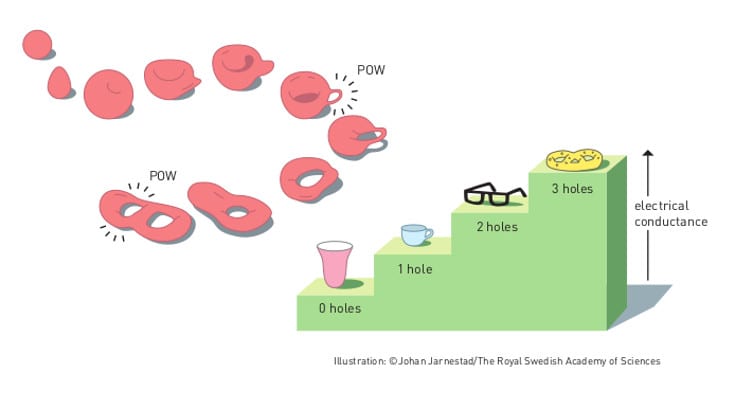
number of holes = topological invariant
According to George Gamow, only number theory and topology had no application to physics. This could no longer be further from the truth, as topology provides new insights in many areas of physics, including the novel topological phases of matter.
Topology groups families of objects into a set that have a certain relationship, it grew out of a mathematical study of geometry. The classic way of introducing topology is to transform a donut into a coffee mug without making any cuts. However, you cannot reshape the coffee mug into a handless pint glass – you have to make some cuts and glue. The hole in the donut and coffee mug makes a difference in the world of topology. The number of holes can be thought of as topological invariant, which can be used for grouping topological objects into distinct sets.
Another famous classical example of topology is the problem of seven bridges in Konigsberg. It was a city, with Pregel River and two islands. The problem was to determine if it is possible to reach all four landmasses by traversing all four lands only once. Leonard Euler showed that it was impossible, formulating the problem in terms of the number of land masses and the number of bridges – the topological invariants. For any city with the same number of land masses and number of bridges, solutions are topologically equivalent.
When was topology applied in physics?
Even before Gamow made his remarks, there were already several minor applications of topology on physics. Paul Dirac’s work on magnetic monopole was based on some topological considerations of Maxwell’s equations. Singularities of gravitational collapse in blackholes were shown by Sir Roger Penrose using topological methods.
It was however in the 1970s that topology came to its prominence. This was due to the gauge theories, where it was introduced. The applications of topology on quantum field theories capable of describing many areas of physics from condensed matter to particle physics were numerous. It was due to topology that we have a Standard Model now.
Towards the end of the 1970’s, topological arguments provided a link between Aharonov-Bohm and geometric phases. It was then realized that there was also a connection to the topological interpretation of the integer quantum Hall effect which was recently discovered at that time. While it has been used by physicists for almost a decade now, it was only recently, with the discovery of topological insulators that it returned to its prominence. This was the start of the research on topological phases of matter and ups until now, it still a fertile ground of research.
In quantum mechanics, quantum numbers are based on symmetry, while topological quantum numbers are pretty insensitive to imperfections. This property offers an exciting possible application, outside of condensed matter; these ideas can also be applied in photonic systems. This principle can also be applied to classical mechanical systems.
Sebastian Huber suggested an idea of using this principle to guide and control sound waves. For electronic systems, the realization of Weyl fermion was due to topology. Another development researchers are currently working is topological superconductors, which is expected to host Majorana fermions. Discovery of the last of the three fundamental fermions could provide a platform for quantum computations.
Source
Many of these topological systems were based on crystal symmetries, but they can also be found in quasicrystals, whose symmetry could not be much further away from conventional crystals.
The application of topology in physics is an exciting field. The development and exploitation of new topological phases of matter are still in their early stages. Topology will be prevalent in the most areas of physics.
very interesting stuff!
only one minor advice. For me as an interested reader it would be great if you could add an link to a book, publication or anything else where I can find further information, especially on the topolocigal insulators and how their transitions work.
I'll work on that bro. I tried as much as possible to make the subject of topology in physics readable for everyone. In the future, I'll post more with links, books, publications or perhaps even equations.
Thanks for the advice.
This post has received a 0.09 % upvote from @drotto thanks to: @sinbad989.
This post has received gratitude of 1.99 % from @appreciator thanks to: @sinbad989.
This post has received a 2.72% UpGoat from @shares. Send at least 0.1 SBD to @shares with a post link in the memo field.
To support our daily curation initiative, please donate 1 SBD or delegate Steem Power (SP) to @shares by clicking one fo the following links: 10 SP, 50 SP, 100 SP, 500 SP, 1000 SP, 5000 SP.
Support my owner. Please vote @Yehey as Witness - simply click and vote.
This post has received a 27.37 % upvote, thanks to: @sinbad989, @sinbad989.
Awesome post, and awesome initial introduction! I'd glimpsed mentions of topology in physical before and though it refered to only the geographical sense of the world... to say i was confused would be an understatement. :)
Thank you, fellow science enthusiast.