Artwork explained #7 : American Gothic
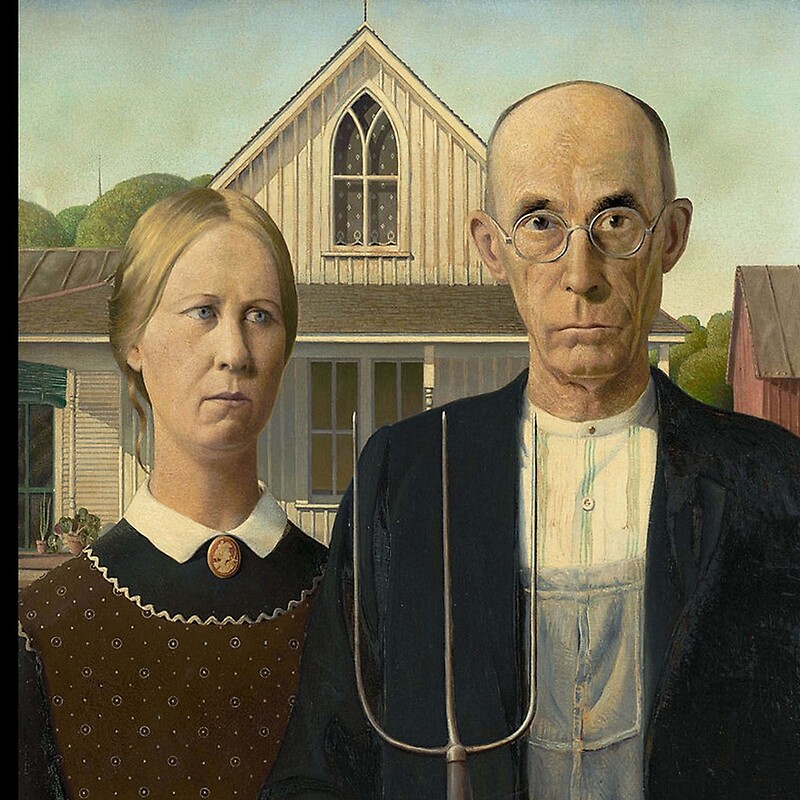
American Gothic by Grant Wood
DESCRIPTION
American Gothic is a famous painting, parodied many times and has been consecrated by popular culture, immediately recognizable by most Americans as a classic work of the 20th century.
Painted in 1930 by Grant Wood, this simple work was inspired by the architecture of a 19th century farmhouse and the people who lived in these homes.
The main characters in the painting are an old peasant holding a fork - which probably symbolizes his role as a worker - and a woman by his side, who can be seen as his daughter or sister. The man is wearing overalls and a dark coat. The woman wears a typical 19th century apron, which seems to symbolize her mainly domestic role, with a black dress underneath. His collar is white and adorned with a small pendant. Behind the characters stands a light-colored house and what appears to be a barn next door. Some trees are visible further in the background. Wood's sister and his dentist served as models for the characters.
INSPIRATION
Wood was driving through Iowa, trying to find some kind of artistic inspiration, when he passed by Dibble House, a farmhouse built in the Gothic architectural style. He found the house interesting and according to his brother, would have sketched at his first visit. Wood looked the house as having a very "paper mache" style and thought that his Gothic window looked absurd in comparison to the rest of the house. He asked the owners permission to paint the house and made an oil sketch with a slightly different shape, with a steeper roof and a longer aspect of the building. These artistic modifications are taken into account in the house of American Gothic. This is how the house is actually the main subject of the painting, while it is in the background.
CRITICAL ART
Grant Wood finally participated in a competition organized by the Chicago Art Institute. While the judges found it difficult to take the painting seriously, they were finally convinced by one of the museum's patrons to reward the painting with a bronze medal. The Art Institute of Chicago also purchased the painting, which remains to this day.
The painting was soon photographed and toured the local media. While its reception was generally positive, several critics were raised among the people of Iowa, who found that they appeared to be essentially Puritan hooligans in the countryside. Wood claimed that this was not his intention and that on the contrary, he admired the people of Iowa that he wanted to represent in his painting.
The painting was widely praised by critics, although many thought it was a parody, an attempt to portray rural America in a negative prism, which was fashionable in the artistic and artistic worlds. literary. Nevertheless, it was not his original intention, since Wood himself enjoyed life in the country.
SOME FUNNY PARODIES


@siavach, Happy Steemian, Salsa Dancer and Photographer
This painting was saved from obscurity by parody becoming one of the most famous painting from 20 th century.
I really enjoyed your post, thank you!
Nice post bro!
At this time what is cost of this picture? i am still laughing because of funny pics are made using Art of 1930 by Grant Wood.
good picture . you are nice photographer
nice and funny editing :P i like this artist <3 upvote
keep sharing
@sibtainali
most famous paintings in the history of American art.
great post
Art history is a great way to preserve and learn about cultures. Thanks! Following you :)