Crash course on epistemology
Epistemology is to scientists what ornithology is to birds. Two obvious facts about ornithology are that it cannot be an ornithologist who has seen nothing but feathers, and that even the most seasoned of them will never be able to fly.
Science as a mode of communication
Science is made up of propositions about the Universe, accompanied by a method to validate them, that is, a way of assigning them one of the two possible truth values true or false.
The scientific method consists of doing such validation in an empirical way, using a systematic mode of observation of reality called experiment. The steps to do any experiment are carefully registered, and published togheter with the results. This makes science objective, by validating its propositions in a way that is completely repeatable by any other interested person in any other time and place. For this reason, the subjectivity of the scientist is subtracted from the process of accumulation of knowledge.
(CC0)
Other non-scientific modes of communication
What other modes of communication can be compared to science?
For example, religion and mystical discourse in general. Like science, they consist of propositions about the Universe, but unlike it, validation does not refer to systematic observations, and is therefore not repeatable by interested third parties. In other words, it is not objective but completely subjective. The believer knows that his religion is correct, but cannot describe to the skeptic what series of steps he must repeat to convince himself of the same.
Art is another mode of communication. In this case, no propositions are transmitted, but instead emotions are directly interchanged. The artist communicates something that most of the time cannot even be put into words, much less assign it any of the truth values true or false. It can only be felt.

(CC BY-SA 3.0, photo by Papamanila)
The scientist's subjectivity
Returning to science, the papier-mâché epistemologist often vehemently questions its objectivity, based on the obvious fact that it is made by people, and people have subjectivities. The problem is that this approach is made without previously defining what is meant by "subjectivity" and "objectivity".
Reviewing what has been said above, when we say that a proposition is true or false, our claim is objective if we accompany it with an operative recipe following which any other person could be convinced of the same thing. If such a recipe does not exist, the statement is subjective.
In other words, the very definition of scientific knowledge leaves the subjectivity of the nerd on white smock out of the problem. And it is not a matter of opinion, there is nothing to discuss here. It is simply the definition of the word "science".
Baby sciences
It is a historical fact that all sciences were born from something that was not, and slowly evolved incorporating more and more objective validations of their propositions, until achieving scientific status. Astronomy emerged from astrology, chemistry from alchemy, history from myth, and there are morea lot of additional examples.
At present, there are many new sciences that barely touch the scientific character, having incorporated very few propositions with objective validation. This is particularly evident in the human sciences: sociology, economics, psychology, etc.
These baby sciences are full of propositions without any objective validation, which are accepted as theoretical hypotheses to analyze their consequences. This is not a criticism, part of the natural development of a scientific discipline is to start that way. In any case, the criticism is that very often the practitioners or the popularizators of such disciplines do not keep sufficiently in mind the hypothetical status of the non-validated propositions they use, and their eventual subjective character.
And this is where the bonsai epistemologist steps.

(CC BY-SA 3.0 , by Fretwurst)
The subjectivist fallacy
In general, those who questions the objective nature of scientific knowledge, or its advancement in recent centuries, does so based on the methodological errors of the baby sciences, or of well-developed sciences when they were in their infantile state. This is evident in asking for examples.
No one questions the objectivity of science by talking about modern physics, astronomy, or chemistry. It does so by quoting Aristotelian physics, astrology or alchemy. In other words, concentrating on those sciences when they were not sciences, but proto-scientific disciplines.
When modern examples of scientific subjectivity are demanded, the shelf epistemologist concentrates on the human sciences, which in general contain enormous blocks of propositions not objectively validated. In other words, they are not yet sciences but only potentially.
The refutation
Another common error in toy epistemology is the fear of rebuttal:
If before they were sure of P, and now of Q how can I believe that tomorrow they won't be sure of something different? If they were wrong before, why are they so sure that they are not wrong now?
That problem is simple: scientific knowledge never refutes its empirical basis, that is to say the set of systematic observations that gave it objectivity. It simply narrows its scope. All experiments that supported P in the past are still correct and consistent with P. Only now there are more experiments, and some of them contradict P. Therefore, the perfected proposition today is Q, which includes all experiments explained by P and the further experiments.
Quantum mechanics (Q) does not refute experiments that validated classical mechanics (P). But it also applies to smaller objects, which had not been observed in Newton's time.
Relativity (Q) does not refute the experiments that validated Newtonian mechanics (P). But it also applies to faster objects, which had not been observed at that time either.
Of course natural selection disproves the Lamarck's inheritance of acquired characters. But here the problem is that the idea of Lamarck never had an objective validation. It was a proposal for a baby biology, not a scientific fact in the modern sense. The same often happens with sociological, psychological, or economic hypotheses.
The epidemic of epistemology with crayons is the result of a failed educational design, which tries to explain how science works to people who never had any contact with it. Sometimes not even teachers have.
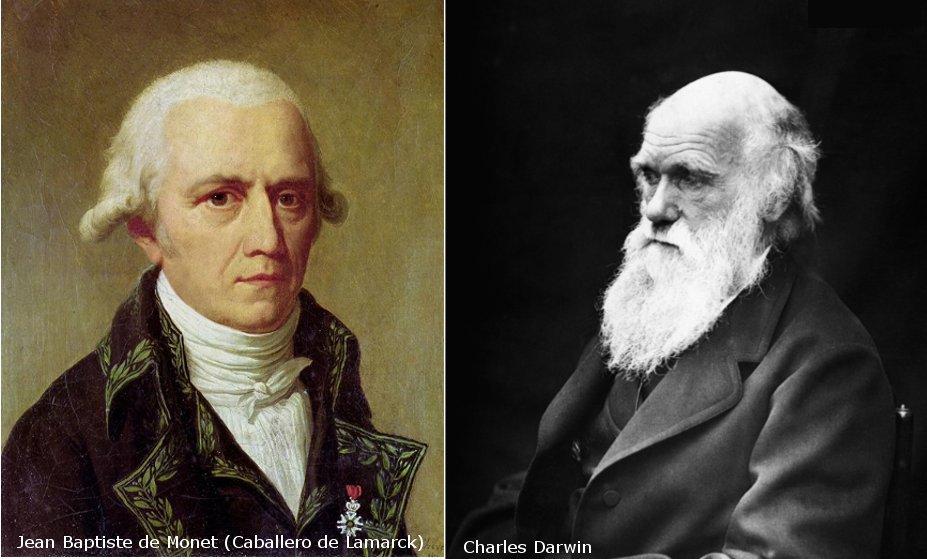
Lamark and Darwin (CC BY-SA 3.0, by Alejandro Porto)
Moral
Let us set a basic rule in discussions about the scope of scientific knowledge: when we make general statements about science, let us accompany them with concrete examples, in modern and well-developed sciences. Let us avoid using a baby science to model the scientific method. It is not honest and it does not work.
My posts (mostly in spanish) are published in
- Cave Canem (ciencia, opinión)
- Literatops (literatura, citas literarias)
- Diaspora*
- Mastodon
- SteemIt
- Telegram
- Tumblr
I can also be contacted in
This post has been voted on by the SteemSTEM curation team and voting trail in collaboration with @curie.
If you appreciate the work we are doing then consider voting both projects for witness by selecting stem.witness and curie!
For additional information please join us on the SteemSTEM discord and to get to know the rest of the community!
Thank you very much!