debonair village (bird palace)

The post was inspired by @Qurator's photo contest, which gave this week the prompt: "Rule of third"; so I've found this capture in my recent folders.
What is this rule about? It is a simple principle of composition, based on dividing your frame into nine parts grid. The rule states that prominent elements of a composition should be placed along one of these lines or at their intersection points.

| location: | St.Petersburg, Russia | date: april 2020 | --- |
| camera/lens: | Canon 5D | +Sigma 150mm | raw-conv |
| f2.8 | t 1/200 | ISO 250 | --- |
This Feathered Friends Village was hard to shoot, being a complex object. When I discovered it in the yards, I spent about 15 mins trying different options (limited to that I was borrowing only macro-tele lens with me). On the picture below you see the whole shape of this 'tree'. I tried two backgrounds: the yellow wall of some service unhabitated shed, and the brown brickwall of an old house on the 1st photo. The goal was to divide the object from the background in the best way possible, and to convey in all details the unusual shape of the object. Maybe its only a series of photographs will convey its originality and all the outlike, but not a single separate photograph.
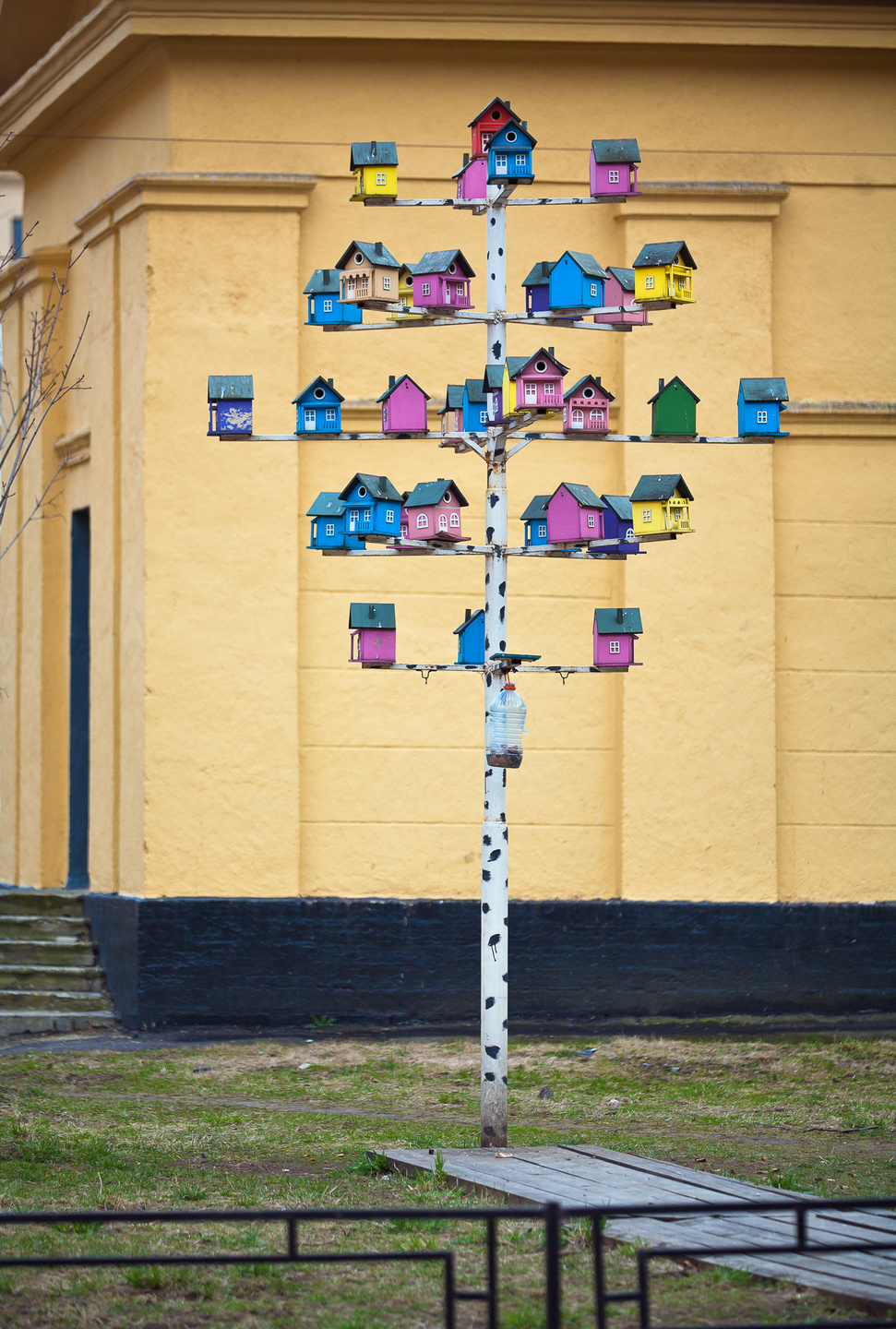
Perhaps I rarely remember about the rule of thirds in particular, but when composing my photos, I always rely on the grids and apply the said rule almost automatically (depending on the plot, ofc).
The best compositions are dynamic; photographers often create non-dynamic, static photos. One of the easiest ways to do this is just to center your subject. Easiest way to avoid that is to tilt your angle by 45 grades -- but it is hardly the best option to use it on the regular basism cause result is too annoying.
Thats why you should use the rule of thirds instead! If you want to create truly dynamic images, try placing your subject at a rule of thirds intersection point. This will immediately create a more dynamic composition.
If an image is too busy, then you have a cluttered scene, one's eye doesn’t know where to rest. Placing objects at the grid will help to avoid the clutter. Whenever you’re faced with a messy scene, keep the rule of thirds in mind.
I will add now some more pictures from this set, tho maybe they will add nothing new; just some more nice visuals.

As you may see, it was not so simple to divide it from the background. And a lot of comparably-sized little trees didnt allow me to choose just any angle of view I like.


This one obviously doesnt rely on the rule of thirds. How does it look like? Just chaotic and messy, too many objects and your eye dont know which one to stay at!
So, I started (naturally, not considering that in advance) from overall landscape, then stepped in a bit closer, trying to reduce the size of my capture to make it look better; I did more shots, then stepped in more etc -- ending with a pack of more or less similar photos, with less objects (separate houses) composed according to the grid.

Its always a good thing when you have something that you can rid off from. Minimalism does the trick! In good and caring hands, it is capable of real magic.


So, dont forget about the grid, the rule of thirds, and -- I simply dont know the correct English translation, but in Russian it is also named 'диктующие линии' (guides).
Hello qwerrie!
Congratulations! This post has been randomly Resteemed! For a chance to get more of your content resteemed join the Steem Engine Team