Killing the Fcoin Comparisons (ABCC)
Killing the Fcoin Comparisons

Speaking on behalf of myself and not the exchange in this statement, I absolutely despise references to Fcoin. I understand why they’re made, but that does not make them any less annoying.
With this article, I’m expecting any and all comparisons to ‘Fcoin’ to cease. Now I’m sure some of you reading may be wondering, ‘What is Fcoin?’
Great question.
Allow me to explain.
The Brief History of Fcoin
So, around the end of June and in the beginning of July, people started to see the gas transaction on Ethereum’s network spike to exorbitantly high prices in comparison to what it had been in weeks past:

Source: https://etherscan.io/chart/gasprice
The primary culprit was the Fcoin Token, an ERC20 token created and founded by Zhang Jian, an individual noted for his contributions to the Huobi exchange.
Now, it’s important to note that Fcoin is the exchange, and Fcoin Token is their native currency.
Somehow, some way this token that was unknown to anyone at the beginning of June had managed to accumulate volume that exceeded that of $BTC at $9 billion per 24 hours.
“How the Hell Did That Happen?”
Through a fraudulent trade to mine program that they had instituted.
Their whitepaper is 404'd now (surprise, surprise), but fortunately, the internet was able to keep an archive of this broken system that they were running on their exchange.
Here’s a screenshot that shows the model that they were trying to operate:
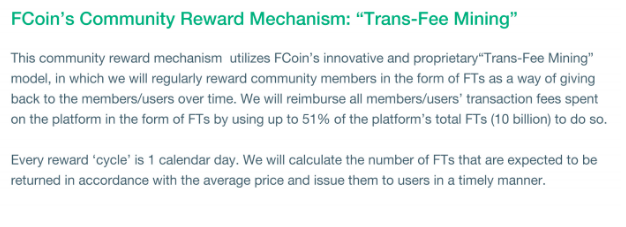
Apologies for the quality of the screenshot, it’s the best one that I could find.
In essence, individuals in the community had all of their transaction feesreimbursed by these tokens.
So What’s Wrong With What Fcoin Was Doing?
Several things.
- This allows the platform to set their own price and valuation for $FT tokens. For example, if you accrued $1,000 in trading fees — the number of $FT tokens that they decide to give you is contingent upon how much they value an $FT token. That’s hardly a free market. In fact, it’s an artificially manufactured market.
- Since there is virtually no cap on the amount of $FT tokens that one can get from such a ‘trans-fee mining’ model, this encourages individuals to wash trade as much as possible. The issue with wash trading is that it gives the fake impression of liquidity in markets where there truly is none, which deceives prospective investors. It also undermines the integrity of the exchange itself if individuals are allowed to do such things freely.
If you’re wondering what ‘wash trading’ is, here’s a quick definition for you:

Source: https://www.investopedia.com/terms/w/washtrading.asp
- Since the exchange themselves held 49% of the tokens unrestricted, they essentially became very wealthy when considering the fact that there was nothing stopping them from liquidating down said tokens.
Fcoin Token Was Quickly Embroiled in Controversy
The community, rightfully so, found out about Fcoin Token’s issuance model, the absurd volume traded on the exchange and the catastrophic impact it had on the crypto community and Ethereum’s protocol and made the prompt decision to lambast the idea and the project publicly.
Coinmarketcap even went as far as to de-list the exchange entirely from their platform, which was a smart move and I personally stand behind said move.
However, the unfortunate impact of Fcoin is that their residual negative impact on the community ended up trickling down to ABCC (a completely transparent and legitimate exchange), resulting in us being branded as a similar project.
However, you will soon find out that the ABCC exchange is absolutely nothing like Fcoin and, in every way possible, is the most legitimate exchange out there in the cryptocurrency market.
Explaining the $AT Token
So, for those that have been to the website, you’ve probably noticed that there is already a brief write-up on the $AT token that is currently available for viewing.
However, I decided to write this article, in specific, because I know that the write-up in its present form is a bit confusing, I admit.
Part of the reason for that is probably nuances in the native tongue of some of the founding members of the exchange. English is not their first language, so some of the necessary nuance in the explanation that is needed to paint a clearer picture is absent.
But this is no problem, because I will outline every single thing about the $AT token that you need to know in this article. Then, I will show you the numerous additional facets of the exchange that make it an obviously superior choice to any other exchange in existence currently.
Token Issuance Model
Let’s just start with the token issuance model and some of the basics of the token, first.
From the website, you’ll see:
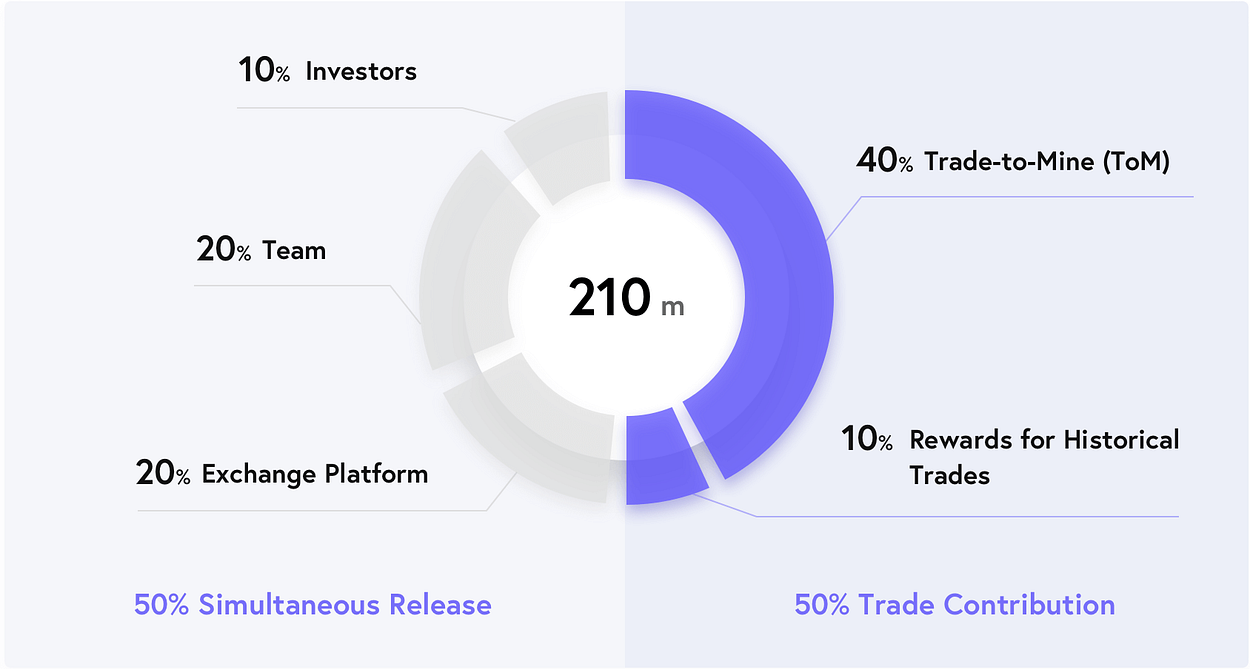
Source: https://abcc.com/about_at
Now, before we get into what gets released and when, let’s break down a few basics here.
There are only 210 million total tokens that will ever be released
On the Left Side of the Circle
- The investors have locked in 10% of these tokens. Investors refers to any venture capital firms or institutional players that decided to invest their money directly into the exchange. That is their entire take of tokens (and no, they do not have them all in their possession currently).
- The team have locked in 20% of these tokens. The ‘team’ refers to the ABCC organization. So, even as a partner and as a working member of ABCC team, I am not directly receiving any tokens.
- The exchange platform itself receives 20% of these tokens. The ‘exchange platform’ refers to the markets for liquidity and market making if necessary. If not, then they will be re-issued.
On the Right Side of the Circle
- 10% of these tokens were issued as rewards for historical trades. These historical trades were trades that were made from the middle of April to June 27th, 2018. For those that remember, $AT token was not launched until July 25th on the exchange (in an official trading capacity). However, if you were trading between April to June 27th, 2018, then you had an opportunity to vie for that 10% (21 million total tokens). The tokens were distributed via an airdrop and the amount of the airdrop that you received was contingent on the total amount of trading fees that you had accrued in that period of time in proportion to the rest of the traders on the platform. So, if you accrued 5% of the total trading fees earned on the platform from April to June 27th, then you would have been entitled to 5% of those tokens that got released, which was 1.05 million tokens.
- 40% of the tokens are reserved for the trade to mining winners. We’re about to explain how that works in great detail, so hold your horses.
How is the $AT Token Released?
So, if you’ve been in our Telegram channel, this is the primary question that everyone has been asking!
How in the world is this $AT token released and how do I earn some on this platform?
Great question. Let’s tackle it, shall we?
So, as mentioned before, 21 million tokens were already granted to the historical trading participants.
So, we can now ignore the ‘10% to historical trades’ section of the circle (on the right side, just cross that out in your mind).
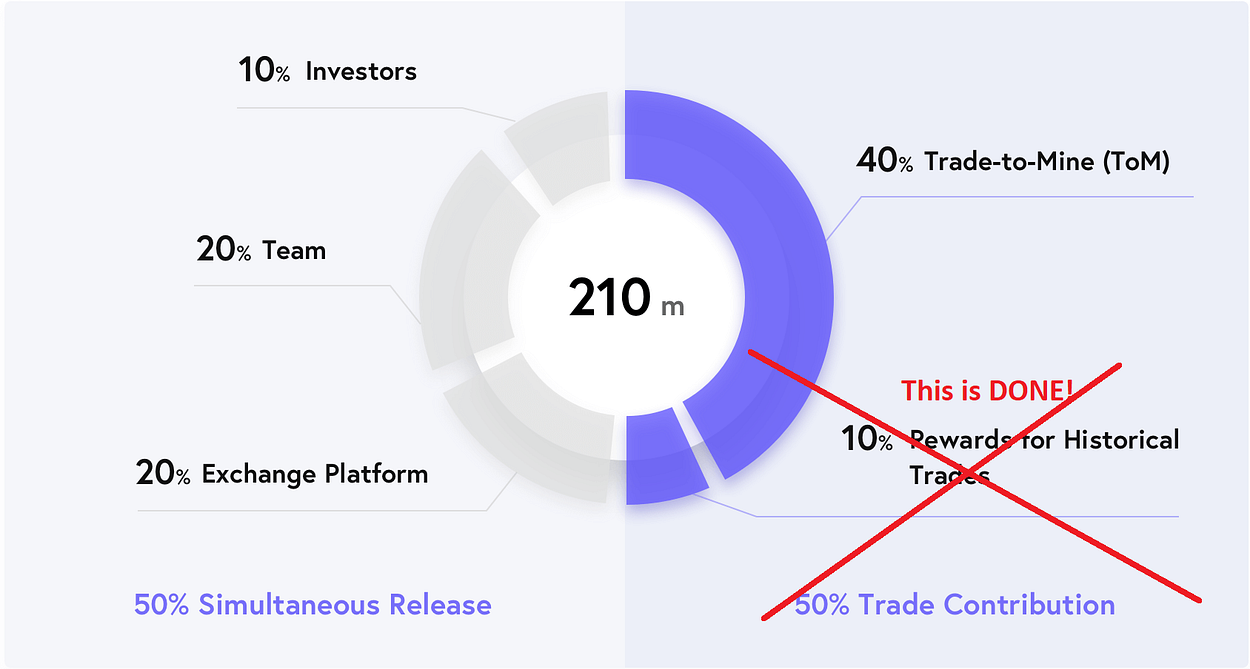
Now, Let’s Look at the Token Issuance Model:

Source: https://abcc.com/about_at
If the above chart confuses you at all, don’t worry — we’re going to break this down.
Here’s What You Need to Know:
- There are 84 million $AT tokens that will be released via this model.
All 84 million of these $AT tokens that are being released satisfy this category (Trade-to-Mine) right here:
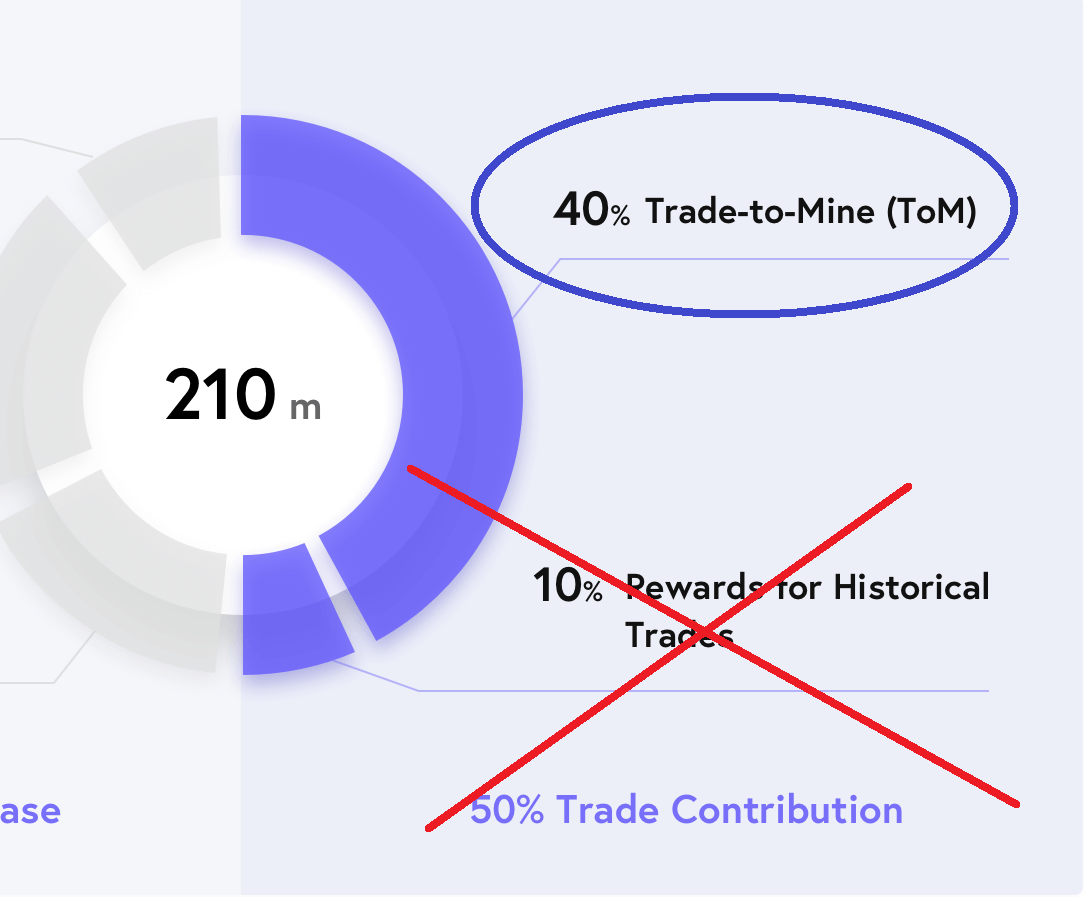
- We are currently in period 1 (one).
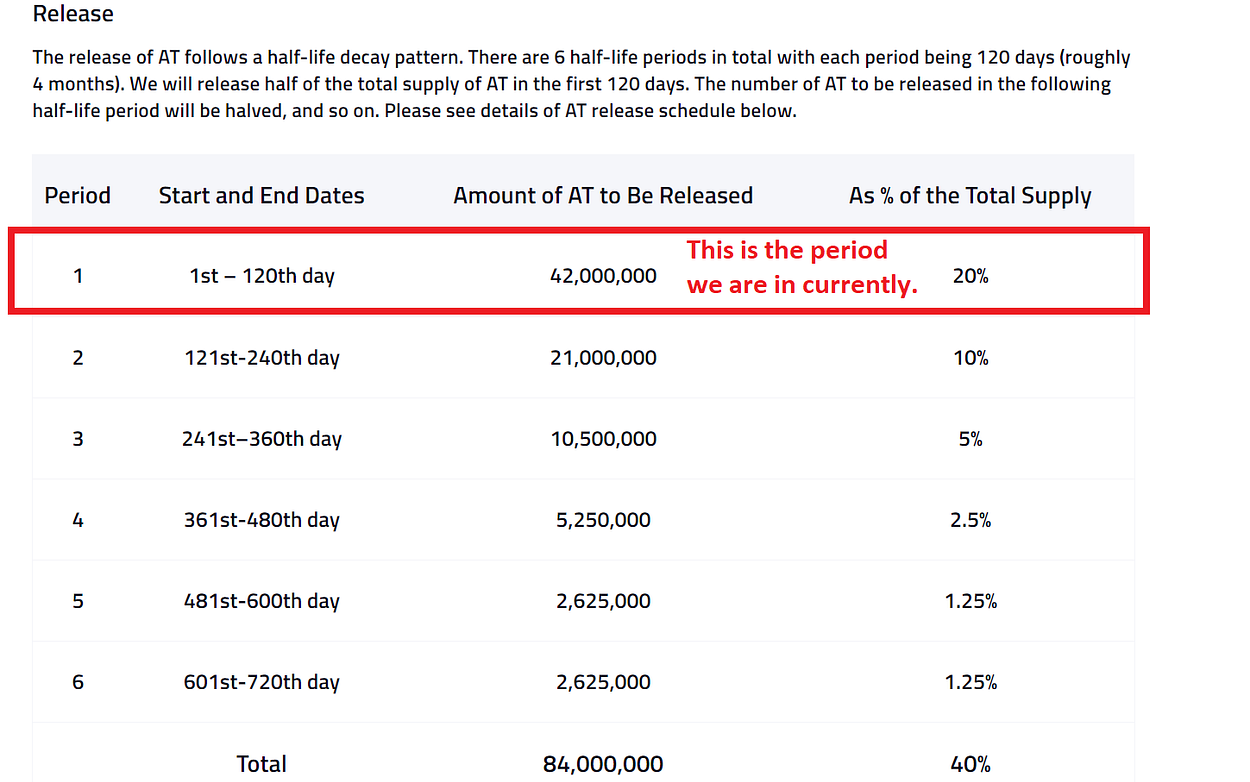
- The first token was issued on July 9th. So, July 9th is the first day of this period. I posted the article where we announced the first day of the ‘trade-to-mine’ period for anyone that might have missed it before.
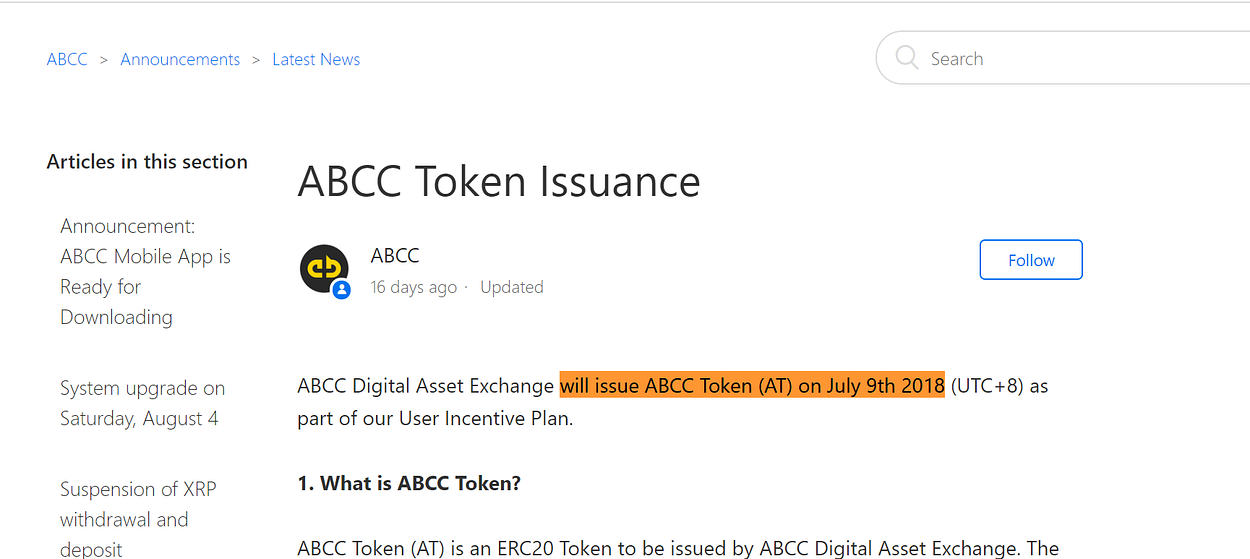
Source: https://help.abcc.com/hc/en-us/articles/360006572332-ABCC-Token-Issuance
- Since the first day was on July 9th, 2018, that means that the last day is on November 6th, 2018. I know this because I just did the math.

How Trade-to-Mine Actually Works
So, now that you understand how these tokens are issued for the next 120 days, you’re going to need to understand how trade-to-mine works as well, which I’m more than happy to explain to you all. Continue to follow me closely.
Check This Out:
- As you saw in the graphics above, during this 120-day period, there will be a total of 42 million $AT tokens that are released.
- These tokens are released every ‘block’, the same way that new bitcoin is ‘mined’ every block.
- However, instead of 10 minutes per block (like Bitcoin has), $AT tokens are released every 6 hours.
- Doing the math, we know that there are 87.5k tokens that are released every block. [Math: 42 million tokens/120 days = 350k tokens/day. 1 Day = 24 hours. 24 hours contains four separate 6-hour time blocks. Therefore, 350k tokens (reward released per day) divided by four (number of 6-hour time blocks), gives us our answer. So, 350k tokens/4 = 87.5k tokens. That’s how we know there are 87.5k tokens released every 6-hour block].
- The distribution of $AT is simple. Your individual trading fees in said block correspond with the number of $AT that you will be rewarded with. So, if your trading fees amounted to 5% of the total trading fees in a given 6-hour block, you would receive 5% of the $AT being released, which amounts to 4,375/87.5k tokens from that block. Simple as that.
“But Wait, Isn’t That the Same as Fcoin?”
No.
Here Are a Few Key Differences:
- There are a finite number of tokens that can be won per block (87.5k). On the illegitimate Fcoin exchange, the number of tokens you could win in a given day was without limit
- You are not rewarded based on how much you trade, but in proportion to your trading fees. On the fraudulent Fcoin exchange, if you and 100 other people have $1 million worth in trading fees, you’d each be receiving $1 million worth in Fcoin. On this exchange, you’d only receive 1% of the tokens being released during that time period and the same would go for your colleagues/counteparts.
- The value of the $AT token is irrelevant in this equation. For the Fcoin exchange, they were rewarding individuals with their native token in relation to the going exchange rate the day before. So, if the Fcoin token was trading for $10/each, then they would take [trading fees/$10], and award you tokens that way. Obviously, that’s not a legitimate setup for a plethora of reasons. On the ABCC exchange, conversely, you will receive the same number of $AT tokens regardless of price. It does not matter whether the tokens are going for $5,000/each or just $.00001/each — if your trading fees only represent 5% of the total trading fees on the platform, then you will only receive 4,375 tokens. Period. No debate.
Conclusion
So, as you have hopefully gathered from this article, there are a number of different ways in which we are entirely different from Fcoin, despite holding a similar premise.
In essence, we serve as their legitimate counterpart. The implementation of a great idea in a safe and legal manner that does not hurt investors, and that should be something that everyone can get on board with.
Thus, we are more than happy and proud to announce ABCC's token issuance model as well as the profit model of the exchange, because we have designed it in such a way where victory for the investors is almost guaranteed.