Nostalgic Game Design Focus - Hill Street Blues

Source
"Ahead of its time" comes to mind.
Think 'Grand Theft Auto' from the perspective of the cops and you get an idea of what to expect from 'Hill Street Blues' ! This game, based upon the critically-acclaimed-but-never-truly-popular television series of the same name, has you take command of a police precinct with an aim of keeping the streets of a city region free of crime.
Welcome. This is 'Nostalgic Game Design Focus' a series where I get to think back and comment upon games that I had played when I was much younger - mostly from a game-design perspective.
Title: Hill Street Blues
Publishers: Krisalis Software
Developer: Krisalis Software
Designer: Rob Hill/ Incley, Mark
Programmers: Incley, Mark / Pashley, Simeon C./ Little, Nigel / Hill, Robert J.
Artists: Incley, Mark / Pashley, Simeon C./ Kavanagh, Tony / Hill, Robert J./ Adamson, Neil / Harrap, Pete
Composer: Furniss, Matt
Released: 1991
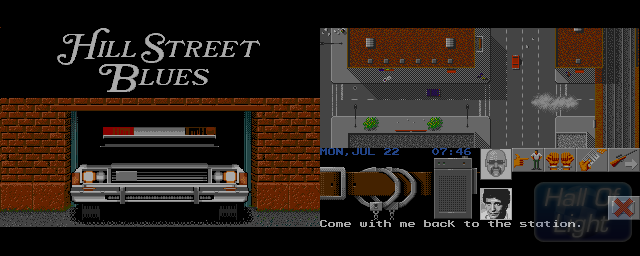
'Hill Street Blues' was not a game that I'd play often, but it was a game that fascinated me. The game was top-down but the play area was a city! And it was populated with people, cars and even featured its own public transport system. Oh and it actually changed from day to night and back again. Those were amazing things to me at the time... and this game was released a full 7 years before 'Grand Theft Auto'.
At times I would simply watch the game play out. It was relaxing to do so - even if crimes were happening all the time.
Source
Premise of the Game
You take on the role of "Captain Furillo", a protagonist in the Hill Street Blues series, and you've been assigned to this police precinct to keep the streets clean of crime. Helping you to do are nine police officers, all from the 80's TV series, whose actions you control, travelling the city by car or on foot, and going about solving crimes as they are radioed in by the dispatcher.
The aim of the game is to solve as many crimes and help the people of the Hill Street area while retaining a high enough popularity to get promoted to Chief of Police. Of course, things could get so out of control that you might instead get replaced.

Source
Game Play
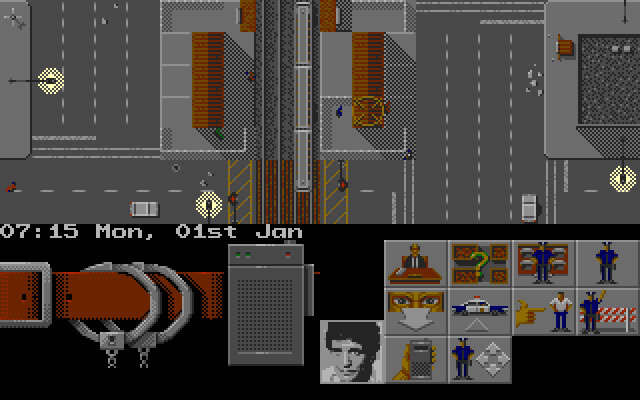
In this top-down real-time strategy game you mostly assume control through point-and-click actions in the button panel below the world/ active screen.
There are a variety of modes (and I didn't truly appreciate them back then) that one will find it useful or necessary to switch to or between.
Furillo's Office
This is the 'command center' for the game and it is here that you get to take on management-related duties.
These options are presented in a point-and-click type setting where various objects take you to particular functions. And all this presented in the visually pleasing format of an office setting.

Source
From here you can click on various things and I really appreciate the User Interface considerations taken:
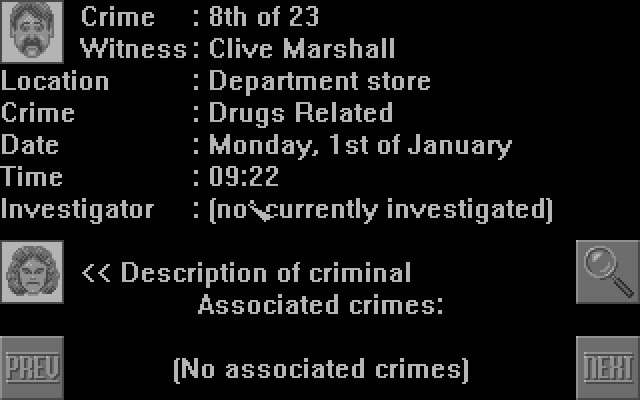
Computer - Police Database - Starting out rather sparse, this is the database of crimes that need to be solved. The case files will include the kind of crime committed, location, age of the case, who is investigating it (if anybody), and what cases are linked to the case. From here also officers may be assigned to any given case.
Wall Map - Patrol Grid - Shows the entire city in miniature. From here you can allocate officers to patrol zones. this is an important strategic decision as areas with a police presence are less likely to spurn new incidents of crime.
Filing Cabinet - Game Statistics - Besides an overview of the game and your progress (crime-rate, success rates, popularity ratings), you can also get additional details on an officer-by-officer basis.
Source
Out on the Streets
Out on the streets you can control the actions of any of nine police officers (each representative of cast members of the TV series).
They are mostly the same - but not all have the same features. The most notable example is 'Hunter' who has the ability to call out a SWAT team, and I recall some officers moving faster on foot than others, but I do get the nagging feeling that there are more subtle differences than those noticed all those years ago.
When assigned to a case one can direct an officer to get to location on foot or by car. They are pretty good drivers and follow the street regulations (if I remember correctly you needed to 'first' select a destination and 'then' opt to walk or drive - though you could manually control them on-foot). You an speed your traversal a little by turning on the siren - and watch with satisfaction as other cars got out of your way.
It was actually quite well done. Again, this was 1991.
The car would automatically park in the vicinity of your destination and then the on-site investigation could begin.

Source
Another well-done moment is the way that they require that you call for a paramedic or coroner to take away the injured or dead respectively (although I personally think that an ambulance should have arrived on the scene sooner or later anyway - these citizens have surely heard of emergency numbers).
Then you can look around and start interviewing people in the area in search of a suspect. If your officer recognizes a suspect then s/he will be highlighted with red arrows - but this will not always be the case - especially with the more dangerous criminals for whose crimes there were no witnesses.
In their case you literally need to be perceptive of individual behaviors. If a citizen is actively avoiding you or hanging around or running away - then that is a pretty strong indicator.
Furthermore, trying to approach certain suspects will either have them make a run for it or open fire, wounding your officer.

Source
This was only a likelihood in some of the more violent crimes. There were seven categories of criminal - and the following is a list in order of their severity and likelihood to turn violent.
- Bag-snatchers
- Muggers
- Pickpockets
- Drug peddlers
- Armed robbers
- One-Off killers
- Serial killers
Furthermore, a person who manages to get away with a crime (or not stopped in a timely fashion) is more likely to relapse or even take a step up the criminal ladder.

Source
In this game an officer who gets wounded needs to have another officer call the paramedics for him or her - and civilians are clueless to the art of emergency numbers - or maybe they just don't want to get involved. I confess that I don't remember ever calling a paramedic for fallen officers, presuming them dead... Oopsie! If I had then thy would have been temporarily unavailable while they recuperated.
Well - to get back to approaching suspects, one could either fine and warn them or arrest them. One could also opt to shoot first and ask questions later. Doing so was similarly a matter of selecting the rifle button and pint-and-click on the target. Bystanders could be shot also. Another thing that I hadn't realized was that having multiple officers on the scene reduced the odds of being violently resisted. Makes sense.
The Courtroom
When more serious cases were hauled back to the precinct there would be a scene where your officer would need to identify the accused to the courtroom. It always angered me to find my memory fail me and select the wrong person only to see the suspect get off for their crimes - but it did happen. :cP
Source
Popularity - the Ups and Downs
Well... if your popularity among the people goes below 20% then you will get fired. Game over.
If you spend some time with an approval rating above 90% you may get promoted to chief of police. Game over. :cP
The people in this game may seem like little clusters of pixels - but they are actually pretty smart. They know if they are walking in the vicinity of a corpse - and will seek to avoid it (but still too dumb to call for help).

Source
Likewise they will be critical of you if you botch things up like:
- Not ensuring that victims are tended to as soon as possible
- Not calling a coroner in a timely fashion
- Not solving crimes in a timely fashion
- Not keeping your crime rate down
- Not arresting the correct people
- Not providing correct testimony in court
- Not failing to be a nuisance to the people (excessive sirens and roadblocks are a good way to tick them off)
- Not abstaining from your gun-slinging and using innocent bystanders for target practice, intentionally or otherwise.
On the other hand, doing things right and solving crimes will up your popularity.

Source
In Conclusion
I personally feel that a game like 'Hill Street Blues' speaks for itself. It feels like a sandbox simulator game in an era before sandbox games were common. Perhaps it is because I wasn't a very social kid but I appreciated how 'lived in' the game world felt - not that I ever got around to getting to know anybody personally.
Its button-based controls were a bit of a let-down, sacrificing intuitiveness in design for easier or even lazy User Interface design - but I kind of liked it overall. Perhaps its retrospect talking.
The formula of the game is pretty rinse and repeat, under the cover. It gets repetitive and yet there is sufficient variety to stave off boredom among a fair portion of the player base.
Source
While - it lacked 'polish' - it made up for it through how faithful the game is to the series of the same name.
True to the series, Sgt. Esterhaus begins each day with a roll call. On duty, radio operator A.J. Hill alerts you to crimes crimes frequently enough. Send officers to the scene, help the victim and call an ambulance or coroner, while trying to identify and find the suspect. When eventually apprehended, the bad guy is arrested, and serious crimes go to trial.
Enjoy those precious moments of clean computer database at the start of the day's shift. There will soon be multiple crimes all over the city, and you'll need to co-ordinate multiple officers simultaneously and keep track of cases and suspects as best as you can. I'm not a big fan of the police but I respect this attempt at simulating law enforcement.
Just be careful out there!

Source
Today's video is really long and I tried to find a decent shorter video but couldn't. It'll give a very good idea of how the game plays - especially if you understand German.
Skimming through will reveal that it was far from a perfect game but it tried to be authentic to the TV series.
Managing nostalgia sure can be demanding! It may not be well-loved as a game but sometimes you need to look at the roots of where one came from to understand where one is headed. Do you have any comments or feedback? I look forward to hearing any comments that you have in the discussion down below!
Also, if you found this post interesting and would like to share this with your followers and friends then a resteem is always appreciated.
Sincerely,
Previous Post: A Real Solution to "The War on Drugs"
Oh pathforger you are too funny. Oddly enough this gave me some ideas for our birdland game - it will be open world world to a certain extent as well.
Gotta love retro!
Hey, I 'really' couldn't find a decent play-through in English - but somebody was playing the german version of the game. :cP
That sounds cool @ecoinstant (and thank you for both your up-vote and comment ^_^). I am looking forward for more information to come out eventually.
Incidentally, a fair number of games are focusing upon including an open world these days. A few (Witcher, GTA, Fallout, etc.) do it very well - but a fair number of games provide the 'openness' without the 'density'.
As such, my suggestion is to begin with an area which is very densely populated with 'stuff' (can include people) and have an expansion plan in place for later in development. ^_~
And yes - I do love retro too - in part as I get to see what much more limited machines were capable of. :c)
Thanks again!