Sidereal objects of our solar system

Credits: Pixabay
Meteor
The meteor is a fragment of rocky or ferrous material that has fallen from the sky. It can be as small as a particle of dust, or weigh many tons. Sometimes, the meteor, when hitting the particles of the atmosphere, gets hotter and hotter, until it becomes red, then white, and finally melts. leaving a bright vapor trail.

Credits: Wikipedia
Sometimes meteors end their dizzying flight and sink into Earth as solid objects, called meteorites. Between Winslow and Flagstaff, Arizona, is the Barringer Crater, a huge hole opened by one of those fragments fallen from space.

Credits: Wikipedia
It has a diameter of approximately 1,200 meters and 170 meters deep. Some believe that the meteorite is sunk in the center of the hole. Others assume that the explosion was so great that it became gas. It is estimated that the crater occurred approximately 50,000 years ago.
In the museums there are many thousands of meteorites. One of the largest known, was discovered by Admiral Peary in Greenland. He brought to the United States a meteorite of 34 tons that is exhibited in the American Museum of Natural History, in New York.
 Credits: Wikipedia
Meteorite Hoba
However, the Hoba meteor is the largest and heaviest meteorite in the world.
It was discovered in 1920. It is composed of 16% nickel and 84% iron, making it the largest piece of iron on the planet. It has not moved since it hit the earth 80,000 years ago.
But perhaps we have seen and trod a meteorite, without knowing it. Almost everyone believes that meteorites are huge rocks, but some of them, when they hit the Earth, disintegrate and their particles look like pebbles.
In addition to planets and satellites, asteroids and meteors, there are other members that make up our solar system, comets.
The Comets
They seem to be immense bodies, formed by icy gases and dust, that revolve around the Sun in very elongated orbits, following different elliptical, parabolic or hyperbolic trajectories. As they approach the Sun they form gas haloes, which often follow them as very long streams, which reach a length of several million kilometers.
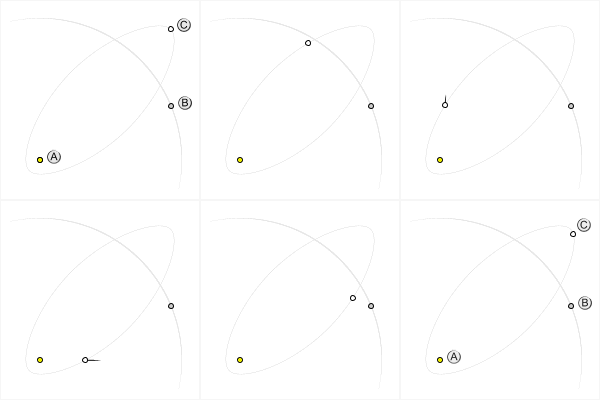
As the comet approaches the sun, its tail goes behind it. But when losing itself again in the space, its cauda precedes it, because both cases of the rays of the Sun, that go towards outside, press against the gases of the comet.
Thousands of comets spin in huge orbits around the Sun, but in the course of life we only see some of them on rare occasions. We know the orbit of certain of these bodies, so we can predict when they will return.
Comet Halley, for example should approach us between 74 or 79 years. It is the only comet with the naked eye that perhaps appears twice in a human life. He was last observed in 1985 and is expected to return in 2061 (This is where I realize I'll be old =( )

Credits: Wikipedia
But many other comets are seen unexpectedly and for the first time. Almost all unexpected comets have such an elongated orbit that they approach Earth and the Sun only once every thousand or more years.
Comets come mainly from three places, the Oort cloud, the Kuiper belt or the scattered disk.
Oort cloud
It is a spherical cloud that is on the "frontier" of our solar system. It contains accumulations of transneptunian objects, that is, objects that are beyond the orbit of Neptune. The Oort cloud is one light-year from the Sun.
Credits: Wikipedia
Approximately, the cloud could contain between one and one hundred trillion objects.
Asteroids

More removed from the Sun than Mars are the asteroids. They are pieces of rock whose orbits are scattered in space, almost all between Mars and Jupiter. But some asteroids approach the Sun until the vicinity of Mercury's orbit and others move away until they approach Saturn's orbit. Everyone, like the major planets, revolves around the sun in the same direction. Some asteroids have almost a quarter of the mass of the Moon, others are the size of a large rock.
An asteroid is an object bigger than a meteor but smaller than a planet, and that is inside the orbit of Neptune. The first asteroid found was Palas, in 1802. It has a diameter of 175 kilometers.
For us, the solar system is our neighborhood and the other planets are our neighbors. Although we consider them neighbors, the dimensions and distances are tremendous. But when referring to the stars we see in the sky we speak of times and distances so great that they are practically impossible to imagine. In comparison with them, the course of a lifetime is only a blink, the centuries pass faster than a sigh and thousands of years are only a second.
When we talk about the distance that separates us from the stars, kilometers mean nothing. For those immensities of space astronomers had to invent a new measure: the light year. Light travels about 10 trillion kilometers in one year.
Light takes a second or so to get from the moon to Earth. It takes more than four years to get to us from Alfa Centaura, which, with the exception of the sun, is the closest star.
When we contemplate the firmament on a clear night it seems to be full of stars. But without a telescope, we see only about 2,500 stars on a clear, moonless night.

Credits: Pixabay
Do not lose sight of the night sky, could happen a shooting star, that is, a meteorite. make a wish! ;)
Greetings steemians...
Sources:
1. Meteorite Hoba - 2. Crater Barringer - 3. Comet - 4. Asteroid - 5. Palas - 5. Oort Cloud - 6. Book "My First Knowledge"
Very good post,
I like Astronomy
Greetings from Berlin
what a good post, very informative.
I invite you to visit my profile, follow me if you like and vote for my last post. Greetings.
Outer space has a lot of wonders, some of which humans have not been able to discover.
I would love to experience a meteor fall one day
I read about the Flagstaff crater caused by a meteorite