Blood Moon
Tonight I read the post about the lunar eclipse, like post @gavet Longest lunar eclipse of the century Tonight, will update pictures as it happens
@terrylovejoy The 2018 Martian Global Dust Storm,
@sauravrungta Knowing Your Place In The Cosmos Can Be An Eye Opener,
@ruth-girl, Don't Miss The Blood Micro Moon Tonight!,
@astrophoto.kevin Large quantities of liquid water discovered on Mars
@azulear La visión astronómica se hace más nítida al descubrir nuevos cuerpos celestes.
@procrastilearner How Fast Are You Moving Right Now?
@svemirac Putovanje Kroz Sunčev Sistem - Asteroidi
I will write some related moon eclipse, The total lunar eclipse will occur on July 28, 2018 and the appearance of this eclipse will be different than usual.
It will be the longest lunar eclipse in the 21st century, according to National Aeronautics and Space Administration (NASA).
And if lucky, you can see it for one hour 43 minutes.
What is a total lunar eclipse?

The lunar eclipse occurs when the Sun, Earth and Moon are in a straight line. This means that the Earth is directly between the Sun and the Moon, so the sunlight is hampered.
The eclipse then occurs when the Moon enters the Earth's shadow.
In different stages, these astronomical symptoms will occur for three hours and 55 minutes.
Why last long?
This is because the Moon moves past Earth's center shadow. This is the widest point of shadow, says Tim O'Brien, professor of astrophysics at Manchester University, UK.
No less interesting, the eclipse coincides with a natural phenomenon called 'planetary procession' that makes the citizens on Earth can see the Planet Venus, Jupiter, Saturn, and Mars.
In particular, Mars will look brighter and bigger when Earth's shadow strikes the Moon.
When and when will the peak of the eclipse?
According to information released by the Meteorology Climatology and Geophysics Agency (BMKG), the eclipse starts at 00:13 pm.
The total eclipse starts at 02:29 WIB with peak eclipse at 03:21 WIB.
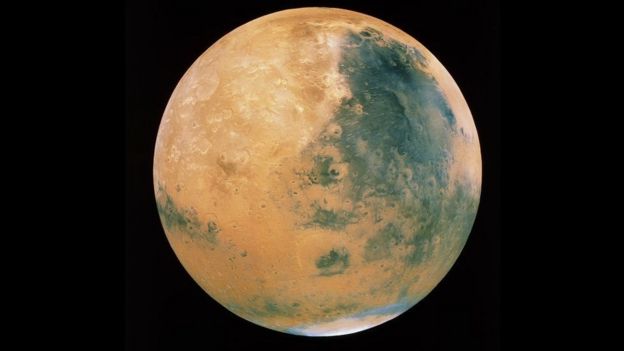
When the eclipse on July 28, 2018, Planet Mars will look brighter and larger than usual.
The total eclipse ends at 4:13 pm and the entire gait process finishes at 06:30 WIB.
Why called the blood red moon?
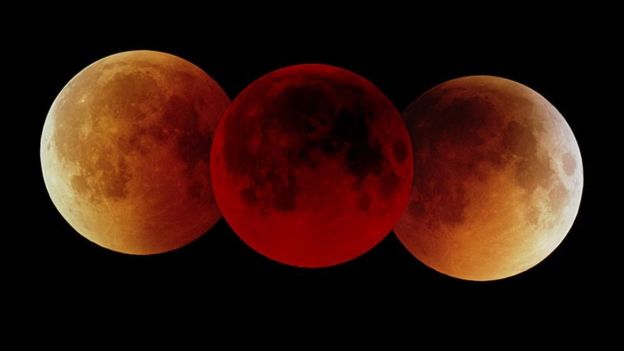
On the night of the lunar eclipse, there will also be a symptom of "blood moon", the name given for its red color.
This happens because of the visual effect when sunlight is filtered into the atmosphere and red and orange are projected onto the Moon.
In addition, during the July 28 eclipse, the Moon will be at its "peak", that is, at the furthest point from Earth.
Where and when can you see it?
The July 28 eclipse will be full in Indonesia on Saturday morning.
In addition, most of Europe, Africa, Middle East, Central Asia and Australia can also see it. Basically most places in the world, except North America.
You do not need a telescope to watch it, but good binoculars will certainly help.
If you are in a place where you can see it, you should be able to watch as the Moon moves up, at its highest point at 20:21 GMT (Saturday, 03:21 WIB).
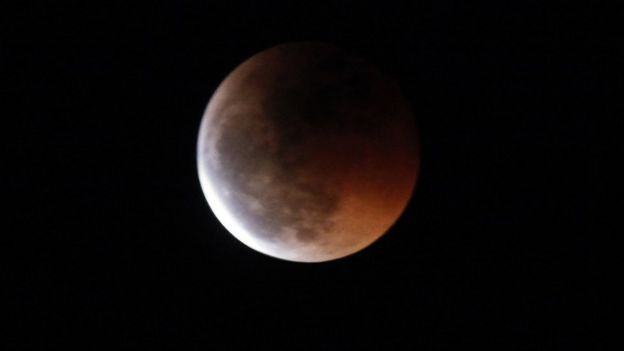
In South America the penumbral eclipse will be seen, where the Earth's shadow closes the Moon but does not inhibit all light.
Who will get the best appearance?
The best place to enjoy this symptom is in the half of East Africa, Middle East and Central Asia.
Eclipses can not be seen in various regions of Central and North America.
In South America, eclipses can only be seen partly in the east, in cities like Buenos Aires, Montevideo, Sao Paulo and Rio de Janeiro.
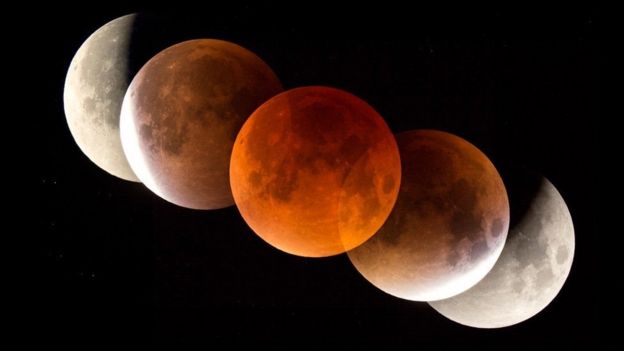
In those cities and other places around it, the eclipse will be visible when the Moon comes out over the equator, the line where the Earth's surface and the sky seem to meet.
The penumbral eclipse will be visible, ie the image will be projected on the moon without covering all the light.
In England, you will not be able to watch from the beginning, because the Moon is still under the equator.
Excellent representation
Thank you @nurhayati !
Thank you very much😎