The Solar System
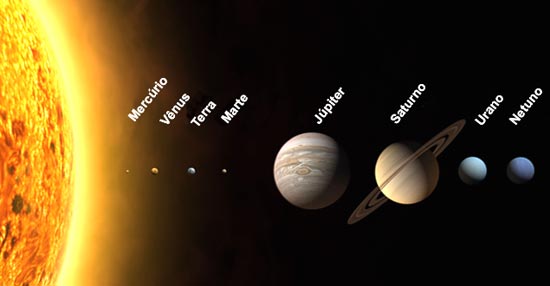
 The Solar System
The solar system is a set of planets, asteroids and comets that revolve around the sun. Each one remains in its orbit due to the intense gravitational force exerted by the star, which has a mass much larger than that of any other planet.
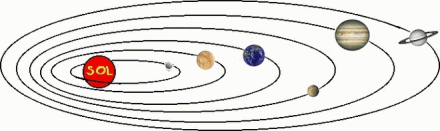
The most important bodies of the solar system are the eight planets that revolve around the sun, describing elliptical orbits, that is, orbits similar to slightly eccentric circumferences.  The sun is not exactly at the center of these orbits, as you can see in the figure below, which is why planets can sometimes be closer or more distant from the star.
  Origin of the Solar System
The sun and the solar system originated 4.5 billion years ago from a cloud of gas and dust that revolved around itself. Under the action of its own weight, this cloud flattened into a disk, at the center of which formed the sun. Inside this disk, a process of agglomeration of solid materials began, which, when collided with one another, gave rise to larger and larger bodies, the other planets.
The composition of such clusters was related to the distance between them and the sun. Far from the star, where the temperature was very low, planets have much more gaseous matter than solid, such as Jupiter, Saturn, Uranus and Neptune. The planets near it, on the other hand, the ice evaporated, leaving only rocks and metals, is the case of Mercury, Venus, Earth and Mars.
The components of the Solar System
The sun
The Sun is the source of energy that dominates the solar system. Its gravitational force keeps the planets in orbit and its light and heat make life on earth possible. The Earth is on average about 150 million kilometers from the Sun, the distance traveled by light in 8 minutes. All other stars are located in much more distant points.
Scientific observations indicate that the Sun is a star of medium luminosity and size, and that there are countless larger and brighter stars in the sky, but fortunately, luminosity, size and distance were exact for our planet to develop forms of Life as ours.
The Sun has 99.9% of the matter of the entire Solar System. This means that all the other stars in the System together amount to only 0.1%. Composition of the Sun
The Sun is an enormous sphere of incandescent gas composed essentially of hydrogen and helium, with a diameter of 1.4 million kilometers. The volume of the Sun is so large that in its interior would fit more than 1 million planets the size of ours. To match its diameter, it would be necessary to place 109 planets like Earth side by side. In the center of the star lies the nucleus, whose temperature reaches 15 million degrees Celsius and where the nuclear fusion process takes place whereby hydrogen is transformed into helium. Already on the surface the temperature of the Sun is about 6,000 degrees Celsius. 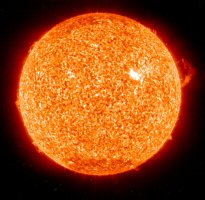 The planets
The planets do not produce light, they only reflect the light of the Sun, which is the star of the Solar System.
Theories claim that planets have also been formed from very hot mass portions and that all are cooling down. Some, including Earth, have already cooled enough to present the solid surface.
A celestial body is considered a planet when, in addition to having no light of its own, it revolves around a star.
The planets are roughly spherical in shape. Its main movements are rotation and translation. Each planet has an axis of rotation in relation to the Sun, the most inclined of them is the dwarf planet Pluto, because its axis of rotation in relation to the Sun is of 120º, look at the figure. 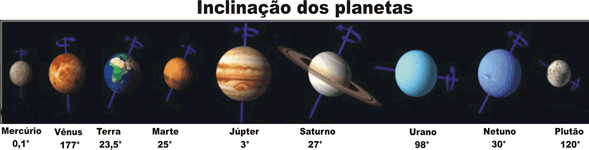 Rotation Motion
In the rotating movement, the planets revolve around their own axis, an imaginary line passing through their center. The terrestrial observer has difficulty perceiving the earth's rotating motion. For this it should be noted that the Sun, from dawn to dusk, seems to move from the east to the west. The same happens at night with the moon, the stars and other stars we see in the sky.
The Earth's rotating motion lasts for approximately 24 hours - which corresponds to one day. The Earth, being spherical, is not illuminated all at once. As the Earth revolves around its axis, the rays of sunlight fall on one part of the planet and the other is in the shade.
The cycle of day and night occur thanks to rotation. While the planet is spinning on its own axis it is day in the regions that are illuminated by the Sun (light period) and simultaneously it is night in the unlighted regions (dark period). 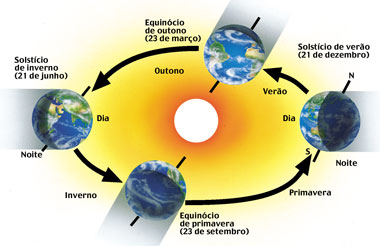 Translation Movement
The translation movement is performed by the planets around the Sun, and the time it takes to make a full turn is called the orbital period. In the case of the Earth this period takes about 365 days and approximately 6 hours to complete. The Earth, in its movement of translation, forms a little elongated ellipse (very close to circular). Already the planet Neptune traces its elliptical orbit in a very elongated way.
Because of the translational motion and tilting position of the Earth's axis, each hemisphere is alternately more exposed to the sun's rays during a period of the year. This results in the four seasons of the year: summer, fall, winter and spring. In the months of December to March, the Southern Hemisphere - located south of the Equator - is more exposed to the Sun. It is when the sun's rays strike perpendicularly over at least some points in the Southern Hemisphere. It is summer in that hemisphere. After six months, in the months of June to September, the Earth has already covered half of its orbit. The Northern Hemisphere - located north of the Equator - is more exposed to the Sun and thus the sun's rays perpendicularly strike at least a few points in the Northern Hemisphere. It's summer in the Northern Hemisphere. 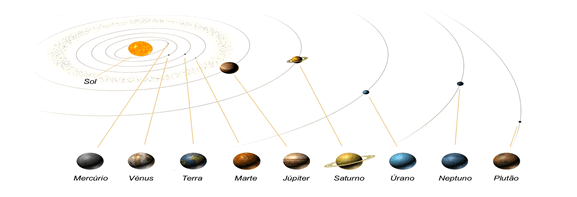 While it is summer in the Northern Hemisphere with the longest days and the shortest nights, it is winter in the Southern Hemisphere, where the days become shorter and the nights longer. And vice-versa.
In two periods of the year (from March to June and from September to December) there are positions of the Earth, in its orbit, in which the two hemispheres are equally illuminated. This is when the seasons spring and autumn alternately occur in both hemispheres.
The seasons of the year are inverted between the southern and northern hemispheres. So it is possible, at one time of the year, for example, that people take advantage of summer on a beach in the Southern Hemisphere, while others wrap up because of a winter blizzard in the Northern Hemisphere.
In regions near the equator, in both hemispheres, the incidence of the sun's rays is constant, and it is hot all year round. There is only the rainy season and the dry season.
Because of the "Earth's curvature" and the inclination of the axis of rotation of the Earth relative to its orbit plane, the poles receive fairly steep Sun rays. For a long period of the year, the sun's rays do not reach the poles; So these are very cold regions.
For the residents of these regions, there are only two seasons:
One that they call winter, that is, the long period when the sun's rays do not reach the pole;
Another call summer, when the sunset does not happen for months.
"This means that all the other stars in the System together amount to only 0.1%. Composition of the Sun" other stars?
Well evaluated, thank you for viewing my post.