Hello Friends of Steemit, following in our accustomed walk through the depths of the ocean, today I want to show you a species that has invaded tdas the waters of the world, it is said that this species can end the marine fauna because they have adapted to survive in Conditions where no species could do it, it is the jellyfish, I will show you the main species that have proliferated especially in the Mediterranean Sea. I hope you like it:
The most common jellyfish in the Mediterranean are three: Pelagia noctiluca, Rhizostoma pulmo and Cotylorhiza tuberculata.
Pelagia noctiluca
Also called "luminous jellyfish" because of its nocturnal bioluminescence, it is small (about 10 centimeters in diameter) and has thin and long tentacles and its colors vary from pink to brownish, and often large banks formed by a myriad of individuals are formed. , which cover some parts of the marine surface.
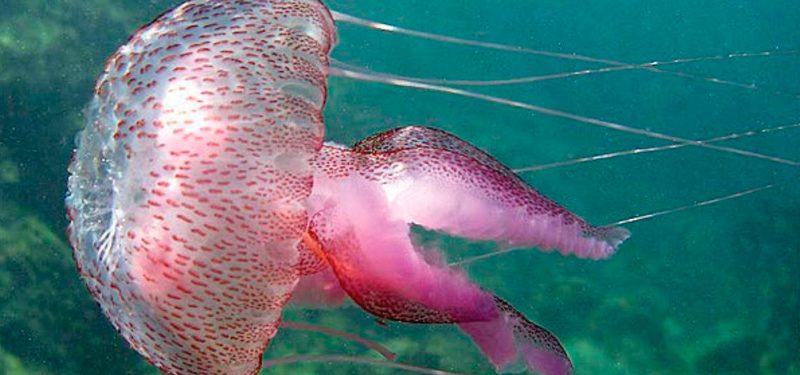
Imagen source
Rhizostoma pulmo
Medusa larger than the previous one, can reach 50-60 cm in diameter, her arms are short and stubby. The color is milky-bluish white and the margin of the umbrella is violet. Vulgarly it is called "lung of the sea" for the presence of the jagged fabric that presents in the central part of the arms that resembles the pulmonary one.
Imagen source
Cotylorhiza tuberculata
This species can reach 30 centimeters in diameter has a disk-shaped umbrella and a series of tentacles also ending with disks, often under the umbrella you can see small fish awaiting the leftovers of the meal of the jellyfish.
Imagen source
Chrysaora hysoscella
Similar to Pelagia noctiluca, for appearance and "malice". The only two differences are in color (the Chrysaora is brownish), and in the way of presenting itself (the latter does not like the "herd", it is almost always isolated).
 Imagen source
The Portuguese Caravel
Luckily, luckily, it is the Physalia physalis, the Portuguese caravel. It is not really a jellyfish, but rather an animal-colony consists of individuals of four different types of the Sifonofori family. It looks like a bluish bladder to the lower part of which are attached the tentacles, thin, very numerous and long sometimes even several meters. It is found in tropical and sub-tropical seas around the world, but has recently been spotted in the Mediterranean, from parts of Sardinia, Corsica, Spain, and even to Malta. It is poisonous: two years ago, a specimen made a victim in Sardinia, the first case in the Mediterranean.
Imagen source
Carybdea marsupialis
Among the bad there is also the Carybdea marsupialis, a relative of the Australian killer jellyfish. The Mediterranean variant is less aggressive and is mainly found in the Adriatic. Unlike other jellyfish it is fast, and stands out because its umbrella is only 4-5 centimeters and has a cubic shape. Pizzica, but its effects do not last long.
Imagen source
Aurelia aurita
Aurelia aurita, the four-eyed jellyfish. Those that look like eyes are actually four rings formed by the gonads, the organs where eggs or sperm are produced. It is whitish, and practically does not sting.
 Imagen source
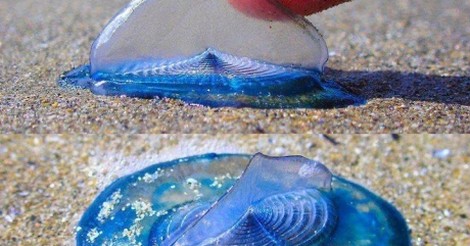
Velella Velella
Velella velella is a carnivorous animal. It catches its prey, usually plankton, through the tentacles that contain toxins. These toxins, although effective against prey, are harmless to human beings, due to the fact that they can not penetrate the skin and cause no reaction to human skin. Nevertheless, it is preferable to avoid touching your eyes after taking a Velella velella. In the shape of an oval disk, with a diameter of 4-7 cm.
Imagen source
Menmiopsis leydi and Beroe ovata
Then there are the ctenophores, which look like jellyfish, but they are not: they do not have poison. It seems they have arrived in the Mediterranean recently but can be met: they are the Menmiopsis leydi and the Beroe ovata. And then there are the salps (those in the last photo on the right), in practice a gelatinous placton. Ugly but inoffensive.
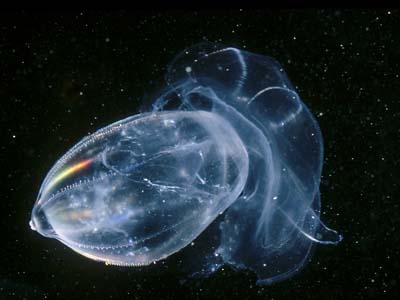 Imagen source
Author's Opinion:
As we could see there are many types of sea jellyfish, to my mind the main ecological problem that bring these jellyfish is that in recent years have proliferated in an exorbitant way, so much that they have chosen to call them the plague of the sea, have mutated in such a way That can be adapted to any environment no matter how difficult its survival in the. Because they have been reproduced by millions have infested the oceans and endanger other species that have had to migrating thanks to jellyfish, climate change also influenced this, which means that we also have some degree of responsibility because climate change is a global problem that we are all responsible for all the main Governments of the world.
Greetings my friends Steemit!
Pages reference:
https://es.wikipedia.org/wiki/Medusa_animal
https://www.medusas.org/
https://www.medusapedia.com/caracteristicas-medusas/


hermosas
Gracias! saludos!!