What is nuclear energy based on?

To be able to define this great term you must first know a very important concept, What is an atom?
Every thing that physically exists has a mass, you, me, all people and everything that exists in this world and universe that has a mass is called matter. If you are looking more closely at any type of material you will see that it is composed of many materials, but if you look extremely close you will reach a point where you will not be able to get closer, and you will see some particles, these particles are called atoms.
Atoms are the smallest unit by which matter is composed, all of us are made by billions of atoms, but are all atoms the same? Well, no.
The atoms are very similar to a solar system, the atom is composed of a nucleus (which would be the sun) and electrons that revolve around it (would be the planets). The nucleus is composed of protons and neutrons (protons have positive charge and neutrons a neutral charge, that's why its name) depending on the number of protons that have an atom, it will be an atom different from another. The electrons have negative carge.
Structure of the atom
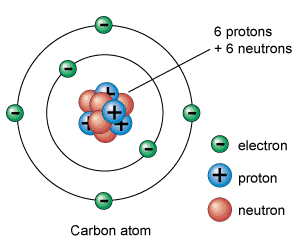
Image obtained from https://www.google.co.ve/search?q=atomo&oq=atomo&aqs=chrome.0.69i59.8618j0j7&sourceid=chrome-mobile&ie=UTF-8#imgrc=vuxUSksqlRA1nM:
Now, knowing all this, we can define the term "nuclear energy", which is also called "atomic energy".
It can be defined as the energy released and / or exploited in nuclear reactions. "Nuclear" refers to the nucleus of the atom, which is why it is also called atomic energy. When we talk about nuclear reactions we refer to the processes of combination and transformation of subatomic particles and nuclei of atoms, these processes can be endothermic (absorb energy) or exothermic (release energy).
There are two nuclear processes that are important to know since one of them depends on nuclear reactors and the other explains how our sun works. These processions are nuclear fission and nuclear fusion.
Nuclear fission occurs when a heavy nucleus divides into two or more small nuclei, as well as some by-products such as free neutrons, photons (usually gamma rays), and other nucleus fragments such as alpha particles (helium nuclei) and beta particles (electrons and positrons). high energy). Nuclear reactors are based on this process, taking advantage of the chain reaction (as nuclear fusion does, but in the opposite direction), since when these free particles are released they collide with the nuclei of other atoms and repeating the process and At the moment of the collision and detachment of these particles, energy is generated.
Example of chain reaction at the atomic level
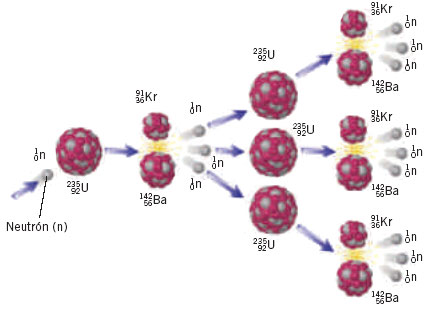
Image obtained from https://www.google.co.za/search?ei=Z89gWr_8G8OzzwKb1YmACg&q=reacion+en+cadena%2C+fisica&btnG=#imgrc=6mGA6F78k2-mGM:
Instead, nuclear fusion is the process by which several atomic nuclei of similar charge come together and form a heavier nucleus. Simultaneously absorbs or releases an enormous amount of energy, which allows matter to enter a plasma state (in another post I will discuss this state in more detail). In nature, nuclear fusion occurs in stars, including the Sun. Temperatures within it are close to 15 million Kelvin. Therefore fusion reactions are called thermonuclear. In several companies, fusion has also been achieved (artificial), although it has not yet been fully controlled.
Example of nuclear fusion, showing the release of energy

Image obtained from https://www.google.co.ve/search?ei=gc9gWqOIBMuTzwLngYu4Bg&q=fusion+nuclear&oq=fusion+&gs_l=mobile-gws-serp.1.1.0i67k1l4j0.1137736.1143384.0.1146046.35.13.3.0.0.0.1233.4699
With all these concepts, humanity has created incredible artifacts, whether for peaceful purposes (generation of energy) or warlike (nuclear weapons), but without a doubt they are objects of great impact.
I thank you very much for reading and that this information has been to your liking, and that this community continues to grow to enrich minds!
Sources used:
https://es.m.wikipedia.org/wiki/Energía_nuclear
https://es.m.wikipedia.org/wiki/Procesos_nucleares
https://es.m.wikipedia.org/wiki/Procesos_nucleares
https://es.m.wikipedia.org/wiki/Fusión_nuclear
https://es.m.wikipedia.org/wiki/NuclearFunsion
https://es.m.wikipedia.org/wiki/Átomo
Source of the initial image:
https://www.google.co.za/search?q=reactor+nuclear&oq=reacto&aqs=chrome.2.69i57j0l3.5175j0j7&sourceid=chrome-mobile&ie=UTF-8#imgrc=C3PsWUBLSxTtdM:
@MuxxyBot