Bizarre Beasts: Amphisbaenians
Most people are at least fairly familiar with the major reptile groups: turtles/tortoises, lizards, snakes and crocodilians (and hopefully the tuatara if you read my last Bizarre Beasts post!). These five groups make up the majority of all reptiles, and represent most known extant reptile species, but there is another, often overlooked, group. This clade is not widely recognized; in fact, very few people actually know it exists at all! This is the group amphisbaenia.

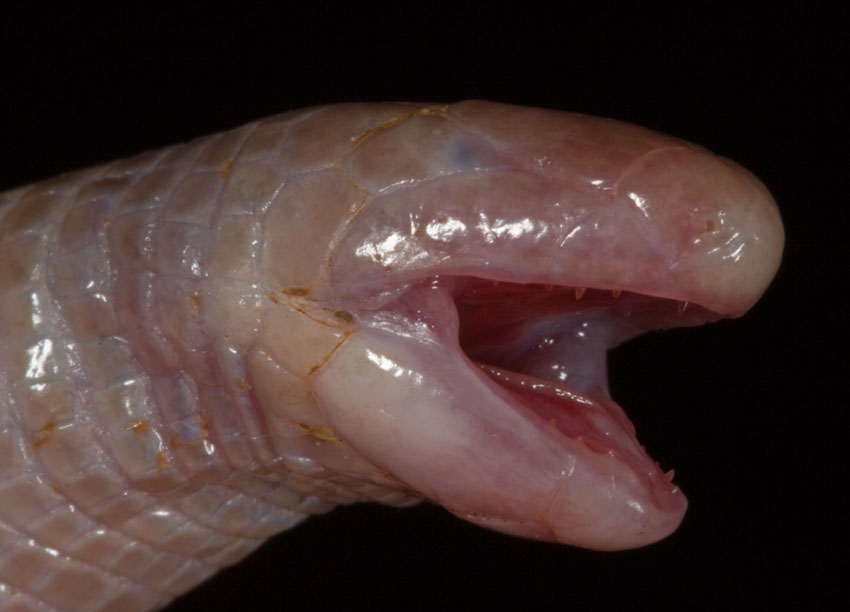
So just what the heck is an amphisbaenian?! Amphisbaenia is a clade of the order squamata, which includes lizards and snakes (they do sort of resemble a cross between the two). Most genera of amphisbaenians are legless, except for one genus, Bipes, which retains its forelimbs (pictured above). Many species are light pink in color and exhibit scales arranged in rings, which gives them the appearance of an earthworm; amphisbaenians are often called "worm lizards" for that reason. Though they appear similar to primitive snakes upon first glance, amphisbaenians do have several features that set them apart from other living reptiles.

Genetics and recent fossil evidence suggests that amphisbaenians lost their legs independently of snakes, and even the legless varieties still retain their pelvic and pectoral girdles (also unlike snakes, amphisbaenians have their right lung reduced in size to fit inside their long thin bodies; in snakes, the left lung is the smaller of the two!). Amphisbaenians are well adapted to a fossorial, or burrowing, lifestyle (hence why they are not commonly known). Their skulls are built to be powerful digging tools; typically rounded or sloped, with a ridge up the middle to break up the earth. Their eyes are deeply recessed in their heads and have actually been covered up by skin and scales. While they lack true vision, these reptiles are capable of sensing light from darkness, the only sense of sight needed for life below ground. Similar to lizards, some amphisbaenians have the ability to drop their tail when threatened or caught by a predator, a process known as autotomy.

The locomotion of amphisbaenians is very unique from other reptiles and amphibians. Their skin is actually loosely attached to their bodies; moving in an accordion-like motion, they move their skin forward, sort of dragging their bodies along. This may be an unorthodox method of travel, but unlike other reptiles, they can move backwards as effectively as they move forwards!

Like many species of lizards and all snakes, amphisbaenians are carnivorous. They are able to attack and feed on prey larger than themselves (most amphisbaenians are no larger than 6 inches), using specialized, interlocking teeth to tear chunks out of their unlucky prey. One species, known as the white worm lizard, is often found in leafcutter ant colonies. This particular amphisbaenian lives in the deeper chambers of the colony, in the galleries where the ants typically deposit their waste, where it feeds on the larvae of large beetles.
Today, amphisbaenians can be found in North and South America, Europe, Africa, the Middle East and the Caribbean, but still remain a mystery to most people outside the biological field. They are very shy animals that are reluctant to leave their burrows, and their small size makes them difficult to understand structurally (it's just difficult to dissect something of that size). They are not commonly found in zoos and aquariums due to their rarity. Amphisbaenians are definitely some of the oddest reptiles out there, but their unique anatomy and behaviors makes them quite special to herpetologists like me!
