The only 2 Egg-laying mammals
It is not easy to make hard and fast statements about any kind of animal. Although we say mammals bear their young alive there are, in fact, two that do not.
One is the well-known Duckbill or Platypus and other is the spiny Anteater, also known as the Echidna.

Both lay eggs!
The Platypus:
COMMON NAME: Platypus
SCIENTIFIC NAME: Ornithorhynchus anatinus
TYPE: Mammals
DIET: Carnivores
SIZE: Head and body, 15 in; tail, 5 in
WEIGHT: 3 lbs
Source
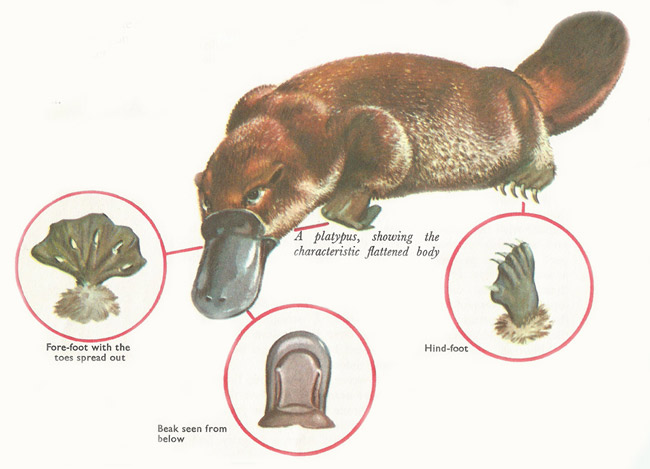
It has tiny eyes and earholes which lie in a groove along each side of its head. These grooves can be closed when the animal is swimming underwater. Its fur is soft and thick, rather like a mole's, and its front feet are webbed. It has five long claws on each front foot and four on each hind foot.
It spends most of its time in water, feeding on worms, crayfish and other small water animals. That is when its webbed feet are useful. When the platypus comes out on land, or when it needs its claws for digging its burrow, it can fold the web back.
When the female is about to lay her eggs she digs a long tunnel in the river bank. She takes care to build walls of earth at intervals along the tunnel, to keep out enemies. She also carries into the tunnel grass and leaves, to make a nest, holding these with her tail.
She lays two soft-shelled eggs and protects them and keeps them warm by curling her body around them. The babies hatching from them are naked and blind. They feed by lapping milk that oozes from slits on the mother's belly. At about four months old they are covered with fur like the adults and leave the nest.
Echidna:
Echidnas can grow from 14 to 30 inches (35.5 to 76 cm) long and weigh 5.5 to 22 lbs. (2.5 to 10 kilograms), according to the San Diego Zoo. Their spines can grow up to 2 inches (5 cm) long.
Source

The Echidna, or spiny anteater, is the other exception to the rule that mammals give birth to live young. The female Echidna lays only one egg which she then tucks into her pouch - a fold of skin on her belly. There the egg stays until it hatches. The baby from it laps milk in the same way as the baby platypus does.
An adult Echidna looks rather like a large hedgehog or a small porcupine. Its rounded body has no tail and is covered with hair, with many spikes poking through on the back. Like the platypus it has tiny eyes and no ear flaps and its muzzle is long and similar to a bird's thin beak. It also has a long thin tongue for mopping up ants and termites, after it has broken open their nests with its strong claws.
When it wants to rest, the Echidna digs a burrow. It does this so quickly it seems to be sinking into the ground. Sometimes it just buries itself under a large stone or in a hollow log. It also searches under stones and logs for insects, especially termites and ants.
An Echidna can go without food for a month if necessary, and in cold weather it hibernates until the weather gets warmer.
Resources & Extra reading:
Monotreme | Extreme monotremes | Platypus Wikipedia | Platapus facts | Echidna Wikipedia | Echidna facts

This animals very nice.
I appreciate steemit education.
I like teamsouthafrica .
Thanks for sharing this post