Central Moscow Hippodrome
Hundreds of times, while driving through the Third Transport Ring of Moscow, I glimpsed the building of the Central Moscow Hippodrome and thought: "I wonder how is it inside? How is everything arranged? ". All the time I passed by, so I never looked there. Only a couple of times I stopped in the parking lot in front of the racetrack: I called someone. Only once, as part of a group of curious people with cameras, I finally visited the Central Moscow Hippodrome and photographed something. I suggest reading my little story about this event.
Earlier I was mistaken and believed that the racecourse - it's stakes, excitement and the path to complete ruin. It turned out all the more serious. Hippodrome is necessary primarily for testing the results of breeding and breeding work in horse breeding, and the tote serves as a pleasant addition to its organizers.
01. 
From the Third Ring Road, you can see the building of the Central Moscow Hippodrome. It was built in 1950-1955 on the project of the architect IVZholtovsky on the site of the old building burnt down in 1949.
02. 
The right wing is crowned with the quadriga of horses, which migrated to it from the old building.
03. 
On the burned-down old building there was another quadriga of horses, but in the fire it collapsed. Now the horses from the second quadriga are installed separately, both on the right wing of the building and on the left.
04. 
We pass the gate with the guard and we get to the territory of the Central Moscow Hippodrome - the first trotting race track of the world, the oldest racecourse of Russia.
05. 
A view of the building of the racetrack from the stands. Tribunes of the Moscow hippodrome are capable to accommodate three and a half thousand spectators.
06. 
We still look at the horses, but for now there is a bit of history. Meet the curator of the hippodrome museum Elena Peterson.
07. 
Elena Evgenievna told us about the horses that were bred in Russia, the famous Orel trotting breed. This breed is hereditarily fastened to the ability to play the lynx of a lynx (a kind of horse's gait, in which it alternately rearranges pairs of legs, located diagonally). Lynx is faster than a step, but slower than a canter. Oryol trotters are used in Russian troikas as root, since Thanks to the lynx well-maintained direction and controlled. Two lateral horses in the Russian troika - pristyazhnye: they must gallop. The mechanism of the triple consists in the fact that the broad-shouldered, sweeping trot of the root-bearer, as it were, "carry" on themselves galloping galloping buckles fastened to the root. Thanks to this, all three horses are getting tired more slowly, but they maintain a high speed up to 45-50 km/h.
The Orel trotting breed of horses was bred in Russia, at the Khrenovo stud farm (Voronezh province), under the supervision of its owner Count A. Orlov, in the second half of the 18th and beginning of the 19th centuries, using the method of complex reproductive crosses using Arabic, Danish, Dutch, Mecklenburg and other Rocks.
08. 
In 1966 a stallion of the Oryol trotting breed named Pion was born. Excellent pedigree type, champion, an outstanding manufacturer! Konezavodchiki not naraduyutsya. All then wanted to get offspring Peony. But suitable mares are not an uncountable number, plus close relatives too (horse breeding does not allow inbreeding closer than 4-5). In general: put the Peony sperm in liquid nitrogen in the hope that after several generations suitable options for its use will appear.
Peony has not existed for a long time, but his genetic material is now used in assistive reproductive technologies to obtain outstanding progeny from his great-great-granddaughters.
09. 
Horseshoe. Winter variant.
10. 
The labyrinths of the hippodrome building make our way to the stands. I've even lagged behind our group a couple of times. The first time I looked at something, I turned, but ours is gone. Where to go, where to find them ?! Well, the organizers' phone was. They found me :)
11. 
The second time I fell behind at the very end of the hippodrome visit. Thanks to the tools of the blog and goodbye to the organizers :)
12. 
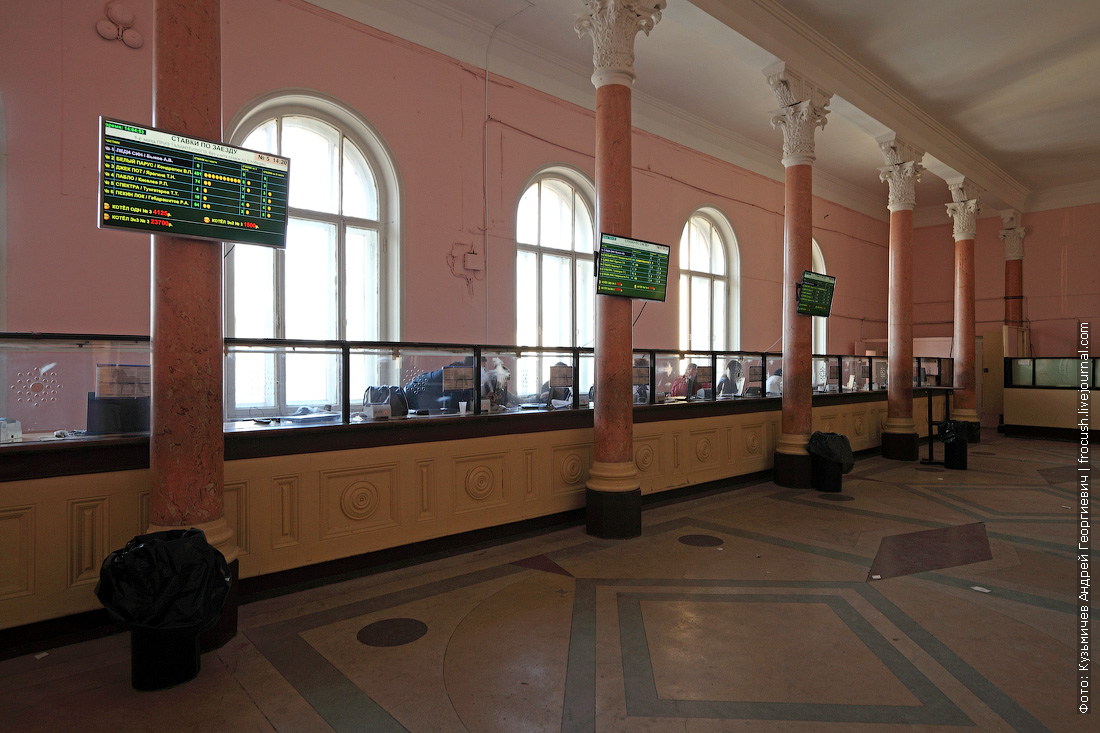
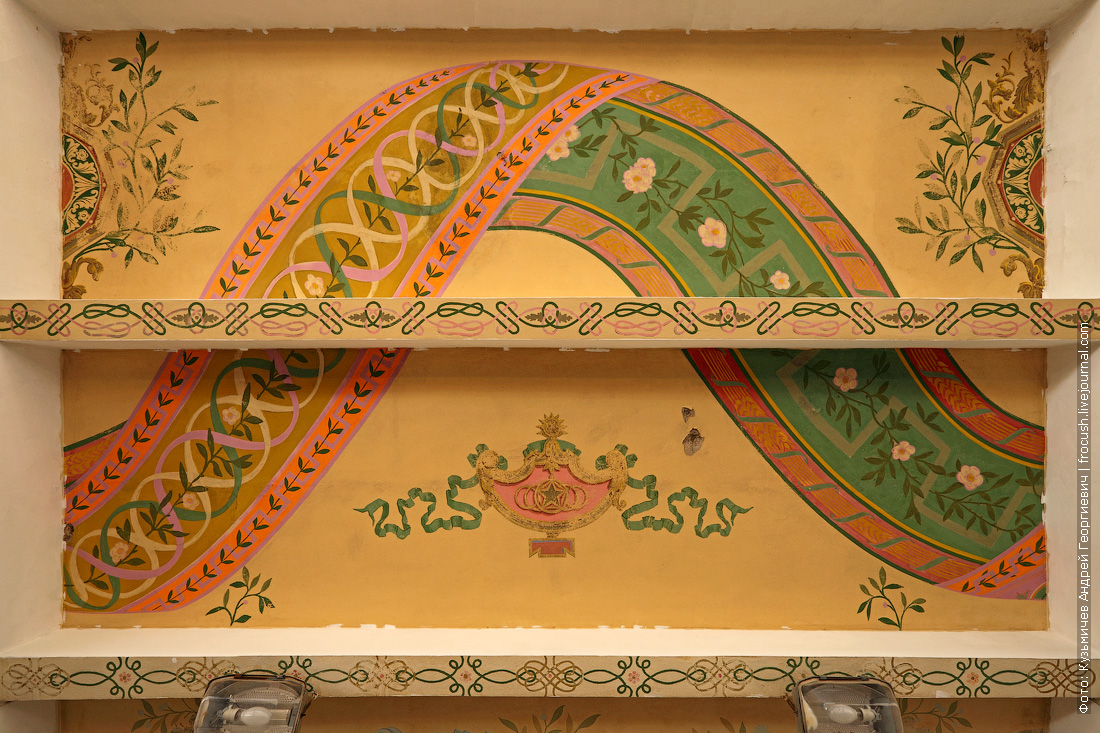
Beautiful inside. All this 50-ies of the last century with interspersed modernity.
13. 
14. 
15. 
Who, who?!
It would be amusing if such a statue on the theme "... in a coat" would be placed at the Department of Human Anatomy.
16. 
17. 
The rostrum of the Central Moscow Hippodrome.
18. 
Imagine. Many cars, traffic jams, jostling and bustle of city life and suddenly: almost in the center of Moscow is a huge space. On the field in colorful coats and helmets, sitting on rocking chairs, riders on horse-drawn trotters rides.
19. 
It feels like I got into some other reality. Something even the airport reminded :) It's also a huge space with unusual objects moving along it, subject to strict rules and commands.
20. 
By the way, one more artifact from the old burned down building of the racetrack: the signal bell. It is installed above the windows of the referees and notifies you of the need to be ready for the beginning of the test, the start of the test and the finish.
21. 
22. 
23. 
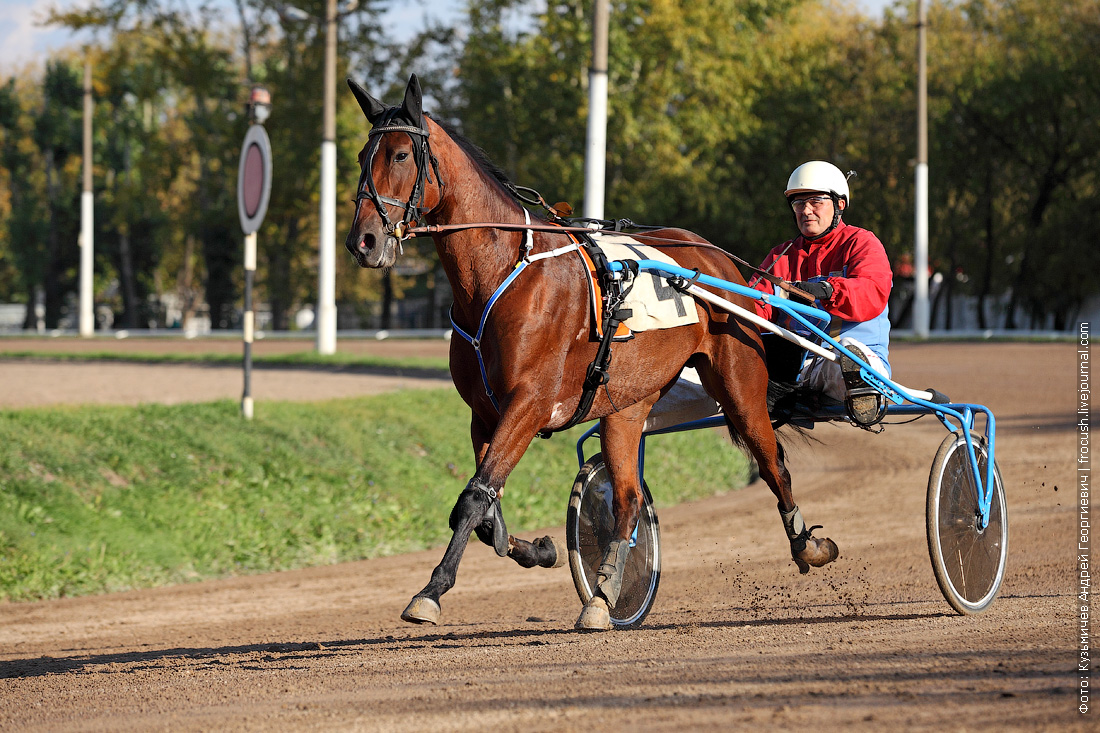
But the actual test of horses of trotting breeds. The distance is 1600 meters. Horses first just run, run to a special car that moves in front of them and level the test participants before the start. Before the stands at the start point the car accelerates sharply, folds the "wings" and disappears from the field of view. At this very time, the time of the distance traveled. 1600 meters of horses run about 2 minutes a minute. If the distance is passed in 3 minutes - it's very bad, it's no good. Running horse can only trot. A short transition to a canter is possible. If the horse continues to race at a gallop, then such a participant is removed from the test. During the test, the rider can lash the horse 7 times. There are no beaten horses at the finish.
24. 
In the left part of the frame, the second machine is visible, which moves parallel to the participants along the inner radius. Judges sit in it and strictly follow the course of the trial throughout the course of the race.
25. 
26. 
Run faster than all? Honor and respect, the red carpet and the stage.
27. 
28. 
29. 
30. 
But the prize goes to the horse-breeders, because the horse won, not the rider.
Congratulate the master-rider Rail Gabdrashitov and his stallion of the Russian trotting breed named Beijing Lok. They won the Talented Prize for horses for two years. This is an important traditional prize for two-year-olds - for trotters of the youngest age.
31. 
32. 
Immediately after the completion of the test, the field gets watered. She pours a sandy treadmill to avoid dust.
33. 
34. 
35. 
There are two tractor trains. Align the surface of the track.
36. 
37. 
The attentive reader has already noticed that some devices are present on the heads of some horses. What is it and why?
38. 
It turned out that the young horse is afraid of almost everything! The horse is afraid of unfamiliar sounds: the ears of a horse are plugged with swabs and put on headphones. The horse is afraid of what is on the side: put on blinders, limit lateral vision. The horse is afraid of what is below: in this case the clutch helps.
39. 
To protect the joints on the feet of the horses wear special pads (nogavvke).
40. 
The Central Moscow Hippodrome is not only a treadmill and an administrative building with stands, it is also a complex of stables with auxiliary buildings. It turned out a whole small town!
Now look at the racetrack from the service side :)
41. 
A local flower bed in the form of a horseshoe.
42. 
Horses on the racetrack have priority in motion. We always gave way to oncoming and passing horses.
43. 
Here in such road haulage horses are brought to the racetrack. Local experts call these carriages "soap dishes".
44. 
Equestrian exercise machine - shagalka.
45. 
During the tests, a crew is used - a prize rocking chair. But for training young trotters it is necessary to use a heavier and stronger motor rocking chair. In the photo it was she.
46. 
For comparison, the prize rocking chair.
47. 
Stables of the Central Moscow Hippodrome. The maintenance of one horse in the stables at the racetrack costs around 15,000 rubles ($255) a month (rent of a place + feed).
48. 
49. 
The interiors of the stables.
50. 
Means for caring for horses.
51. 
Probably boring to stand alone. Horses demanded communication.
52. 
53. 
And then there was nobody. I instead of a horse :)
54. 
55. 
In the town there is everything necessary for horses.
56. 
I wonder how many times you have to fill the watering pad during the whole day of testing?
57. 
On the following shots and you do not suspect that during the tests horses can be afraid of something. Horses, which we saw near, were very curious and willingly posed. Anywhere from us did not hide, but on the contrary, they themselves came up :)
58. 
59. 
60. 
We return to the building of the Central Hippodrome. Paddock. Here, before the start of the race, horses are taken out to the spectators.
On the issue of races and races. What are the differences? On September 28, we looked only at the run, where the horses were ridden by sitting in special two-wheeled trolleys. But in the summer there are also jumps. Here the jockey sits on horseback.
61. 
In the end of the story I want to show a few photos of the trotters made during the test.
Special equipment is put forward to the starting positions.
62. 
63. 
64. 
Start is given!
65. 
66. 
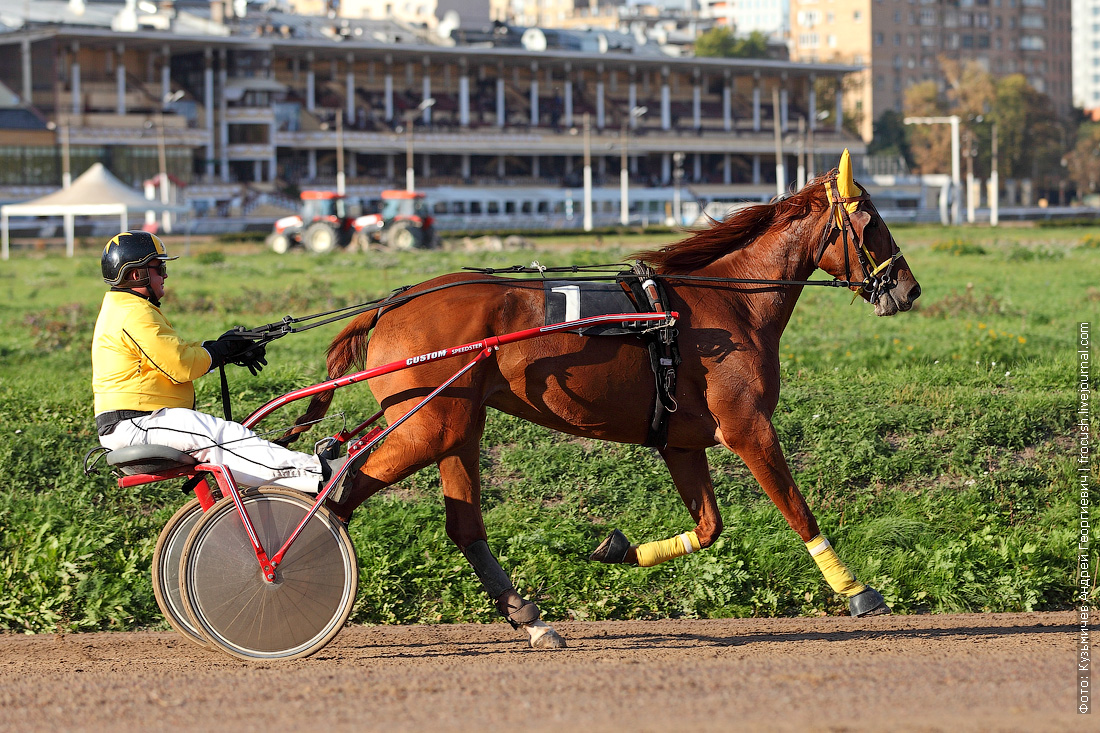
Photos of participants before / after the start. Who recognizes the horse, write a comment: the number of photos, what is the name, age and so on. Complement the post.
Riders are very convenient to distinguish by color and patterns on the jacket. Each such pattern and coloring are unique. What a design came up in the beginning of his career, with this then all his life and participate in the tests. Only a new jacket you sew, if the old one has become worthless. Pattern does not change!
67. 
68. 
69. 
70. 
71. 
72. 
73. 
74. 
75. 
76. 
77. 
78. 
79. 
Pirate's horse.
80. 
81. 
82. 
See how the horse bizarrely bends his legs. Like the screen saver screen "water" :)
In the photo, Alexander Plesser and the American trotter Staro Jazman. The stallion came to us from Sweden :)
83. 
84. 
85. 
86. 
87. 
88. 
89. 
90. 
Until next time!
91. 
Vote for my post and subscribe to my blog!