🎨 Artistic space #9 - Claude Monet's Impressionism
Claude Monet
"The motive is for me entirely secondary; what I want to represent is what exists between the motive and myself."
Claude Monet

Oscar-Claude Monet was born in Paris, France, on November 14, 1840.
A master of Impressionism, he was one of its founders, so much so that one of his works gave its name to the movement that was born in France in the last third of the 19th century: "Impression, rising sun", painted in 1872, now at the Musée Marmottan Monet in Paris.

His father owned an overseas producer's business that went bankrupt in 1845, so they had to move in with his aunt who lived in the port of Le Havre at the mouth of the Seine in 1845.
In Le Havre, he began to paint landscapes of the Norman coast with Eugène Boudin and Johann Jongkind.
After a brief apprenticeship at the Académie Suisse in Paris, he devoted himself to painting outdoors (aux plain air), in a self-taught way, studying in these painting sessions the effects of light and time on nature.

Together with Pierre-Auguste Renoir, he was the first artist to use the loose brushstroke of impressionism.
The aforementioned work "Impression, rising sun" was presented at the First Impressionist Exhibition in 1874, at which time it took its name from the style that many others would follow.
During the Franco-Prussian war, he lived in London and Holland, returning to France in 1872.

He and his family settled in Argenteuil, where they lived until 1878.
During those years, this small town on the banks of the Seine became a colony of painters, the center of Impressionism, in which, in addition to Monet, Camille Pissarro, Alfred Sisley, Pierre-Auguste Renoir, and Édouard Manet, among others, met.
From 1878 to 1881 he lived with his wife Camille and their children in Vétheuil, where she would die.

In this town, much quieter and more rural than Argenteuil, the painter lived his most prolific stage, making a huge number of paintings, unlike his previous stage, focused on the beauty of nature and the capture of solitary landscapes, without figures.
It was in these years when he began to paint a series of his motives, in which he repeated the same theme with different lighting and time of year.

In 1883 he changed his residence to Giverny, a town near Paris, next to the wife of the well-known collector Ernest Hoschedé, Alice Hoschedé, and whom he married after his death in 1891, spending the rest of his life with their children in this place.
From there he made several trips to Normandy, the Mediterranean coast, England, Norway, and Italy.
In the 1890s he began his love of gardening in his home in Giverny, the paintings he made of the beautiful garden he managed to have in his home were the central theme of those years.

From this came the Nympheas series, in which he systematically repeated the motif of his water lily pond. In those years, his brushstrokes became even looser and freer, approaching abstraction.
In 1908 the first signs of Monet's eye disease appeared.
Between September and December of that year, he was with his wife in Venice, where he not only painted but also studied in the churches and museums of the city the works of the artists Titian and Paolo Veronese.

On May 19, 1911, Alice died, and the following year her vision worsened with a diagnosis of cataracts in both eyes.
In 1912 her paintings of Venice were exhibited with great success in the Bernheim-Jeune gallery.
He recovered his sight after two cataract operations in 1923, after which he began painting again, during which time he continued with his series of water lilies until his death.
He died in Giverny on December 5, 1926.
His house was donated by his son and only heir, Michel, to the French Academy of Fine Arts in 1966.

Through the Claude Monet Foundation, the house and gardens were opened to the public in 1980, which after restoration became an attraction for the many tourists who visit Giverny.
One of his 1907 water lily paintings reached a price of $10.5 million in 1989, and the same painting was sold at Christie's auction with a profit of $2 million in November 2005.

This is due to the fact that there are very few works on the Monet market; this sale is only surpassed by the water lily painting "Le Bassin aux nymphets" which in 2008 reached 51.7 million euros at Christie's auction house.

The painting "Railway Bridge in Argenteuil", which was sold in May 2008 for 41.4 million dollars, also auctioned by Christie's; and a painting of water lilies from 1900 which was auctioned at Sotheby's in 1998 for 19.8 million pounds sterling.
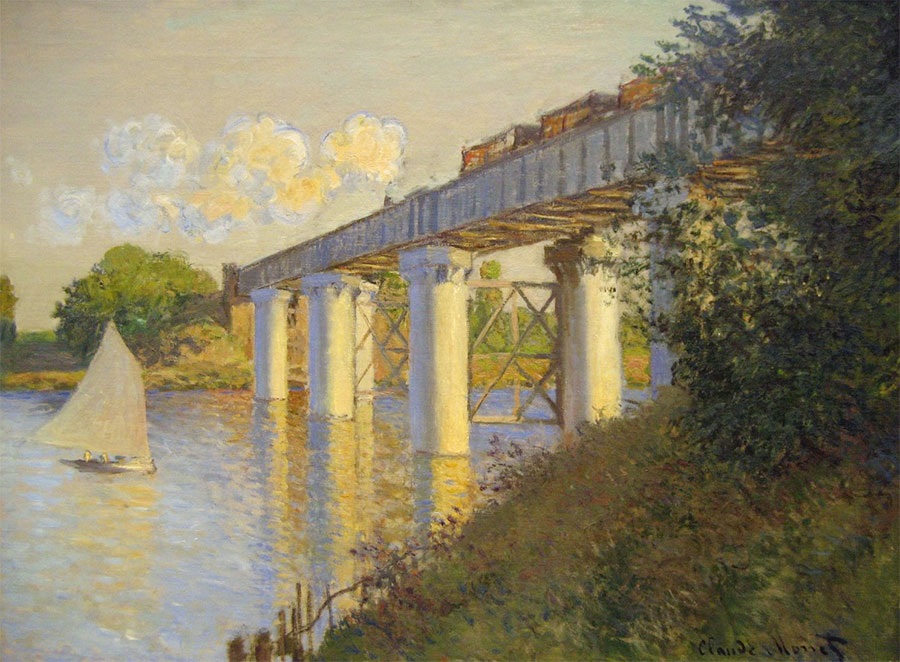
Of all the Impressionists, Monet was the one who most emphatically practiced plein-air (outdoor painting) and no painter in the group was as purely impressionist as he.
Thank you for reading 😊
If you liked reading this article, feel free to FOLLOW ME, UPVOTE and RESTEEM! It's always appreciated =D. Thank you all for your support and see you soon for the news flamingirl's adventures!
Thank you for using this wonderful space for the dissemination of art, I love my vote. my respects.