Cooking & Rotting Science
Dr. Wilson: "House, You just saved my Balls"
𝕴𝖓𝖉𝖊𝖝
2. E𝗇𝗓𝗒𝗆𝖺𝗍𝗂𝖼 𝖡𝗋𝗈𝗐𝗇𝗂𝗇𝗀
3a 𝖬𝖺𝗂𝗅𝗅𝖺𝗋𝖽 𝗋𝖾𝖺𝖼𝗍𝗂𝗈𝗇
3b 𝖢𝖺𝗋𝖺𝗆𝖾𝗅𝗂𝗓𝖺𝗍𝗂𝗈𝗇
4. 𝖥𝗈𝗈𝖽 Preservation
1. 𝗬𝗼𝘂 𝗝𝘂𝘀𝘁 𝗦𝗮𝘃𝗲𝗱 𝗺𝘆 𝗕𝗮𝗹𝗹𝘀
TL;DR:
- Use vinegar or lemon juice to slow down the browning while cooking and use baking soda to increase it.
- Use a combination of acidity, dehydration, vacuum packing and freezing to preserve food and cook.
You just saved my balls
When I took Biochemistry in college Dr. House was in vogue. Then for the first time, I heard an application for the Maillard reaction outside medicine.
In the clip down below, House uses the principle of the glycated hemoglobin tests results in chronically acidotic patients (The window of observation changes from 3 months to 2-3 weeks) 1 with that of the frying meat balls of Wilson, using vinegar to slow down the browning and allow the internal cooking of the meat.
In the real world, one must be careful as normally vinegar is 90% water and you must be familiar with what happens when you throw water into hot oil.
Some chemists even doubt that the effect is significant to slow down the browning, but there's indirect evidence to say the contrary. Example: onions and sodium bicarbonate, The baking soda with an alkaline pH, in fact, accelerates the process.2
Source
Background
Aside from a select group of the population that out of physiological or cultural differences don't enjoy the taste of grilled meat. For the vast majority of us, the smell and taste are exquisite.
Why our brain has evolved to prefer cooked meals is not 100% certain, but it might be due to the creation of new compounds that make the food chemically more diverse and rich. There are great benefits to it like the fact you kill harmful parasites and bacteria by cooking. This also makes digestion easier by denaturing the structure of the food. A process that normally would take longer.
Food naturally degrades over time and here's how this becomes interesting.
Rotting can be of chemic, physic or microbiologic origin.
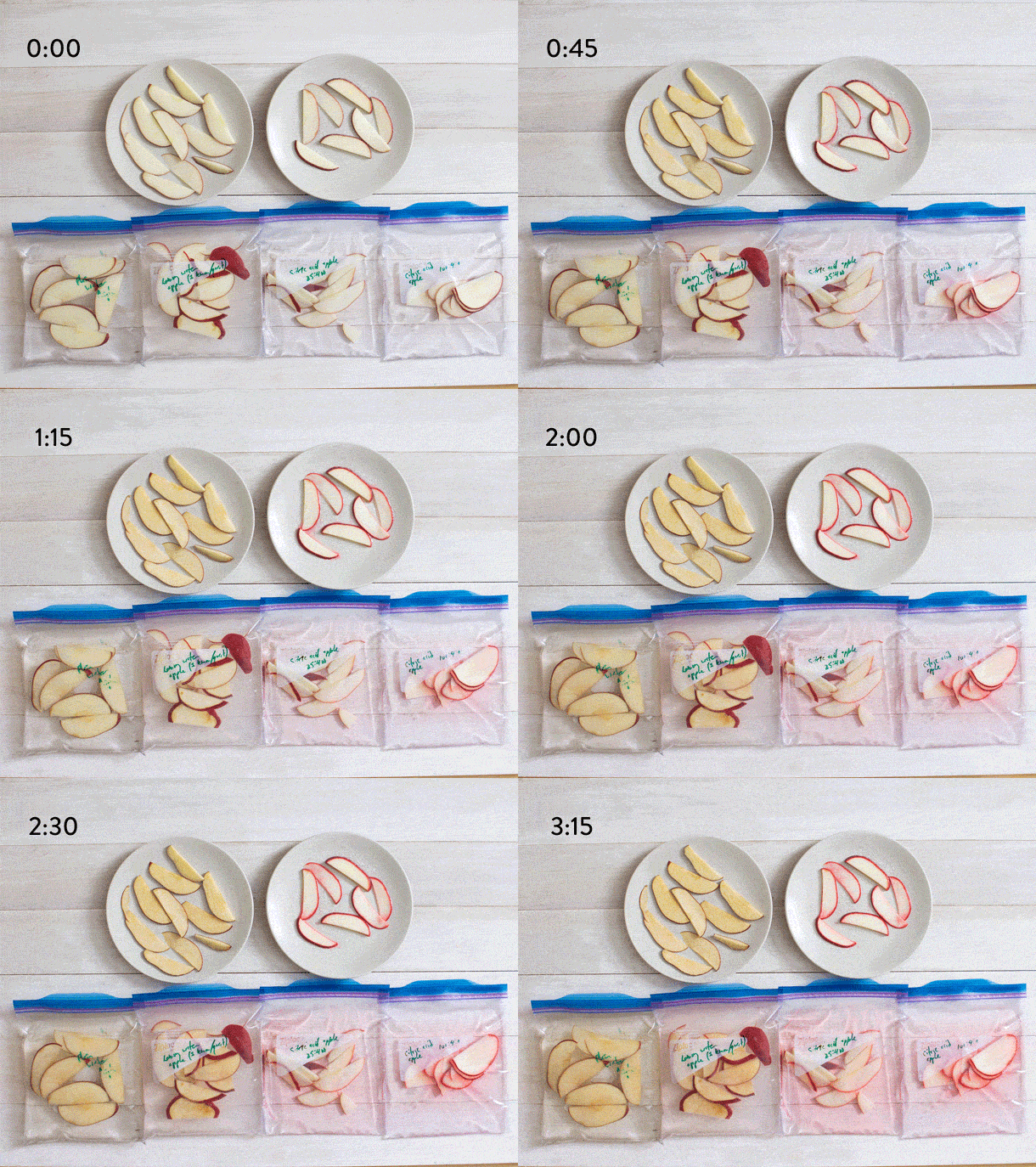
Enzymatic browning is a form of chemical rotting.
 Source
Let's explore for instance fruits.
Normally, the intact cellular structure separates the polyphenol oxidase enzymes from polyhydroxy phenol substrates.
Once this structure is damaged, they come into contact with oxygen and react to produce the undesirable browning seen in fruits like apples. This one is a form of chemical rotting. It can be prevented by adding acids like ascorbic acid that interacts with oxygen before the polyphenols do.
Non-enzymatic browning is a chemical process that combines the carbohydrates and amino acids in food to form complex molecules. There are two types: Maillard reaction and caramelization.
In the Maillard reaction, the carbonyl group of a reducing carbohydrate (a sugar that contains an aldehyde or a ketone group, like glucose and fructose) reacts with a free amino group from an amino acid such as Glycine. 3
Table sugar (sucrose) is a non-reducing sugar, but low pH and high temperatures cause the molecules to hydrolyze. Thus liberating the glucose and fructose to create the brown nitrogenous polymers known as melanoidins
They appear naturally in the body as Advanced Glycation end-products. They are thought to be a contributing factor to aging. Their accumulation is pathologic and is implied in processes like Alzheimer, diabetes mellitus, Retinal disease, atherosclerosis and Cronich kidney disease. 4
This reaction can occur also at room temperature but high temperature increases the reaction rate exponentially. This browning is in almost everything, a cooked steak, baked bread, toast, beer, chocolate, coffee.
Individual amino acids have different smells and tastes. For instance:
Is not all good. For instance, the browning in ketchup and granola is not desirable, we have ways to combat it and to speed it up. I will mention them so you gain some practical knowledge.
The second type of non-enzymatic browning is caramelization. This happens when a carbohydrate is heated beyond its melting point. When you caramelize sugar that hydrolyzes and polymerizes resulting in the caramel color and flavor. The longer the sucrose is heated, the darker it becomes. Mild light colors have a sweet taste and smell. 5
Microorganisms grow on food and their activity or their products can be highly detrimental to human health if consumed. These organisms require a certain combination of conditions to grow normally.
We make use of this to diminish the rate at which they are able to reproduce.
They are not interchangeable their effects are additive.
- Dehydration: The first and probably the oldest form of preservation. By using salts to absorb the water or sugars. Taking away the medium for bacteria to grow.
The water activity (ᵃw), is the measure of the availability of water molecules (unbound water) to enter microbial, enzymatic or chemical reaction. Low activity increases shelf life.
Anything below <0.85Aw is considered shelf stable. Nonetheless, the sweet spot (pun intended) seems to be around <0.5 Aw, where jams and other types of syrups are. This is the reason is a favorite of preservation in canned foods.[6]
- Temperature:
One of the first lines of defense is temperature. In order to get their generation time rolling (the time they take to double their population), most of them require temperatures above 4.4°C (40°F), that's one of the reasons your fridge starts around that number and below 60°C (140°F).
The threshold of >116°C (240°F) and high pressure (10-15 psi) for cooking canned foods are to kill or at least inactivate Clostridium botulinum. 7
- Acidity:
Most microorganisms don't grow on food easily if the pH is lower than 4.6. Acidity is probably the MOST important mechanism. You can see this in effect as most food preservatives are acidic like ascorbic acid [8]
Vacuum preservation:
Different microorganisms have different oxygen requirements:Aerobic: Like molds
Anaerobic: Like clostridium, grows in Vacuum packed and canned foods.
Products like honey have a high antibacterial index, except for anaerobic bacteria. The reason Honey should be avoided in infants below 1-year-old. The spores inside the Honey are enough to trigger a botulinic episode as the mucosal lining is not fully developed.Facultative anaerobic: Like yeasts
Curing: Nitrites, nitrates, salts, and smoke. Nitrates kill bacteria and give meat their characteristic pink color. They help in killing C. botulinum, despite having associated risk with gastric cancer if intake is high with NDMA. 9
Smoking be it by Cold smoking, Hot smoking or Smoke roasting seals with aromatic hydrocarbons the meats, making it more difficult for bacteria to move and enter the food.
Salts are a part of the dehydration process.
10
Hello, as a member of MAP (Minnows Accelerator Project) you are receiving this message (and upvote!) to inform you of some exciting updates to the project.
Firstly, a new collaborative contest called Binary Stars is in pre-launch, with plenty of time to find a partner and enter Round 1.
Also, MAP contests now including voting by MAP members within the private Discord chat; this means you can help decide on our best new quality content creators.
And thirdly, we are launching a new Curated Content article, to be published every 3 days, with priority given to those articles posted within the MAP Room on Discord. We continue to be committed to supporting quality content on Steemit.
We now have over 120 MAP members, so would be good to come and say "Hi!" to some new friends!
If you are reading this and wish to be considered to join MAP, then please go to the current Signup page. Thanks!