Where are the Voyagers?
The Voyager 1 and Voyager 2 probes do not stop making history, more than 40 years have passed since their launch and they are still exploring space in the far reaches of the solar system.
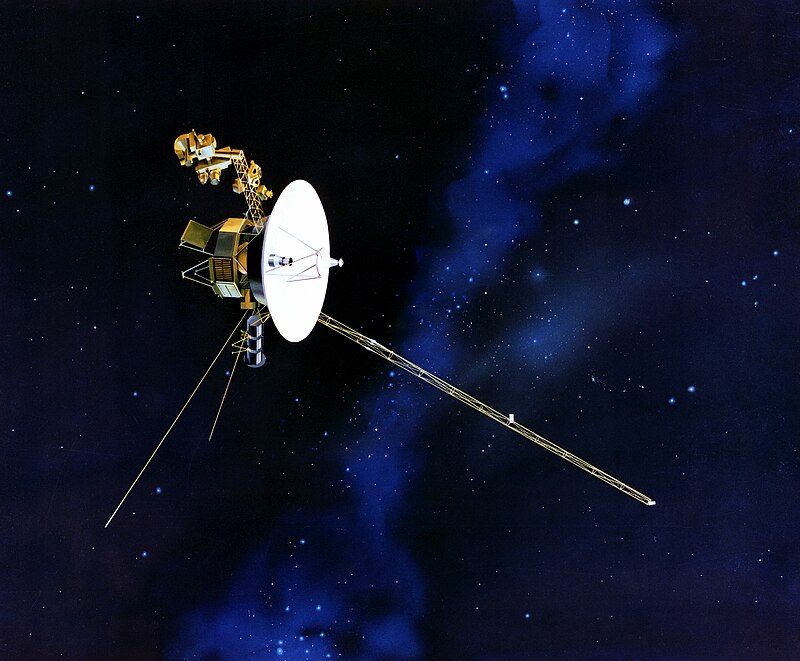
Representation of one of the Voyager probes in space. Source: wikipedia.com.
Among the multitude of vehicles and satellites that have been launched into space, these probes are the first man-made objects to enter interstellar space and continue sending data.
The Voyager probes were launched by NASA in 1977 to study the outer planets of our solar system, the Voyager 1 probe passed by Jupiter in 1979 and Saturn in 1980, while its sister spacecraft managed to reach Uranus in 1986 and Neptune in 1989.
In addition to carrying the scientific equipment necessary to carry out various studies, both spacecraft carry a gold disc with a selection of music from various countries and cultures, a greeting in 55 languages and images including the location of the solar system.
Voyager gold disc titled "The sounds of the earth". Source: wikipedia.com.
After completing their mission to the outer planets, the Voyager spacecraft continued their journey studying the environment of the outer solar system, thanks to the fact that they are equipped with nuclear electric generators that have allowed their instruments to continue functioning and sending signals to Earth.

Trajectory recorded for Voyager 1. Source: Wikipedia.com.
In 2013 NASA scientists reported that Voyager 1 would have become the first man-made object to reach interstellar space, after much debate about whether or not it would have left the so-called heliosphere, after verifying new data confirmed that the spacecraft had left the bubble of hot particles surrounding the solar system and entered the cold and dark environment of interstellar space. On the other hand, scientists confirmed that Voyager 2 had left the influence of the sun in 2018, but still did not leave the solar system, as it is still within the Oort cloud, a cloud of trans-Neptunian objects at the edge of the solar system.
The key to detecting that the two spacecraft jumped into interstellar space was precisely the jump in plasma density detected by their instruments. While they remained in the heliosphere region, they recorded a hot and less dense plasma, influenced by the solar wind, and then began to record the transition to a region of colder and denser plasma, characteristic of interstellar space.
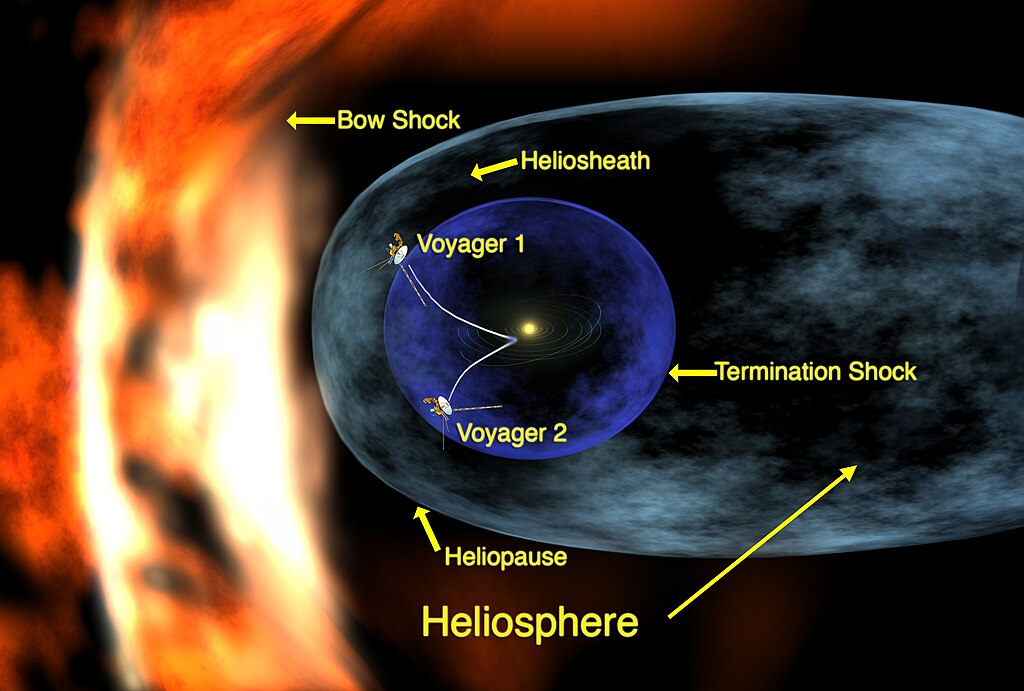
Representation of the Heliosphere and location of the Voyager spacecraft.. Source: Wikipedia.com.
The data collected suggest that the heliosphere is symmetrical in shape, as the points where the probes crossed into interstellar space are at a very similar distance from the sun, suggesting a spherical front in this bubble. Voyager 1's entry into interstellar space occurred at 122.6 Astronomical Units, or AU, while Voyager 2 did the same at 119.7 AU.
Through NASA's Eyes application we can follow the trajectory of both probes, at the time of this publication, Voyager 1 was 23.3 billion kilometers from Earth traveling at 61026 km/h, while Voyager 2 was 19.45 billion km from Earth, traveling at 55112 km/h.
These mythical spacecraft are a milestone of humanity and space exploration, for four decades they have helped us to understand the solar system and more recently interstellar space, and will continue their task of exploration while traveling to the Oort cloud, and when they pass through it, they will continue their journey through the galaxy, although by then their nuclear battery will have been exhausted and the dust and solar radiation will have wreaked havoc on the spacecraft.
Thanks for coming by to read friends, I hope you liked the information. See you next time.
Hello @emiliomoron
Good data that you share with the community, certainly few times we stop to know this kind of information "the heliosphere has a symmetrical shape", it's great to know what we can achieve with this kind of projects.
Best regards, be well.
Hi my friend, no doubt these probes have provided important knowledge. Greetings!
The story of these travelers is very interesting as each of the things that allow us to see how big the universe is and how small we are before its immensity. However I wonder if by launching this kind of objects that later cannot be recovered we are not contributing to dirty space? that is to say that these objects in the end become space debris, isn't it?
Hi @emimoron, these probes have allowed us to know important aspects of our solar system, and well, two probes like these do not represent as much garbage as the amount of debris accumulated in the orbit of the earth, and perhaps with the passage of several hundred years will be reduced by ultraviolet radiation.