What are earthquakes? (Activities)
The slow movements of the earth's crust for humans are almost invisible and safe. However, the earth's crust can also experience very rapid movements: earthquakes.
Source
Earthquakes are rapid vibrations of the earth's crust caused by tremors.
Earthquakes occur due to rock displacements in the depths of the earth. These displacements occur in earthquake centers.
An earthquake source is an underground space in which rocks break and move.
Source
Earthquake sources occur more frequently at a depth of \ (10 ) km. However, they can be deeper, up to \ (700 ) km.
From the foci of earthquakes through the earth's crust, the oscillations propagate until they reach the Earth's surface. The greater the depth of focus and the force of the impact, the greater the area of the earthquake and its strength. The strongest earthquakes occur in the epicenter.
Earthquake epicenter: a place on the surface of the earth, located directly above the source.
The destructive effect of seismic waves.
Source
An earthquake source occurs as a result of a fracture and shear of rock strata. Huge pressure is created, the rocks surrounding the source are compressed first, then expanded and seismic waves are formed, the displacement of the rock particles. The source of a seismic wave can be an earthquake, explosion, vibration or shock. Seismic waves (longitudinal and transverse) propagate from the source of the earthquake in all directions.
The longitudinal wave first reaches the surface of the Earth. A transverse wave goes behind a longitudinal wave, but the force of its impact is greater than that of a longitudinal wave. That is why in an earthquake, the first shock is followed by a second, more destructive one.
How do earthquakes occur?
Of course, earthquakes are one of the most formidable natural phenomena. They bring terrible disasters to people. The oscillations of the earth's crust cause destruction, fires, floods and deaths.
Source
The study of earthquakes showed that they arise due to the rupture and very rapid displacement of large masses of rocks or tectonic plates. Its change and causes strong fluctuations in the earth's crust, which are felt on the surface. Scientists have discovered that the earth's crust consists of about 20 large and small tectonic plates. They have a thickness of 60 to 100 kilometers.
The reasons that cause his movement are many. Wandering tectonic plates, then falling, then rising, float on the surface of the magma. In those places where they touch, and earthquakes occur most frequently.
A large amount of heat accumulates in the bowels of the planet. Outside, the Earth, which warms the world space, cools and its surface contracts. As a result, different parts of the earth's surface experience different pressures. Maybe this will set them in motion.
Earthly vibrations are also affected by gravity. Our planet consists of substances of different specific gravities. Lighter rocks tend to rise and heavier rocks fall.
Its movement is affected by the gravitational forces of the moon and the sun.
A change in the speed of rotation of the Earth also leads to deformation of the earth's crust.
Seismic waves
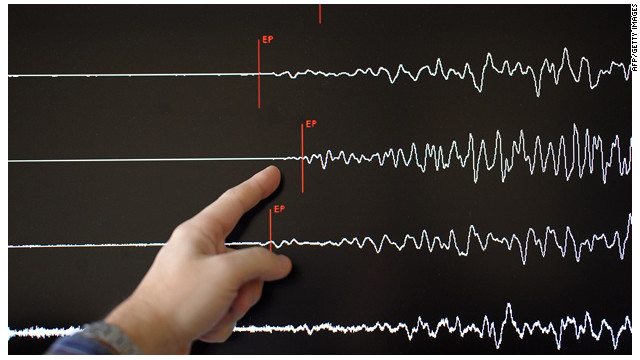
To detect and measure seismic waves, a seismograph is used.
Source
During an earthquake, a seismograph measures the types of seismic waves. The oscillations of the earth's surface are fixed with the help of a load suspended in a spring; It does not move unlike the rest of the device.
A vibrating pen on a paper tape captures horizontal or vertical waves. Molecular electronic seismographs do not have paper tape, and are suitable for underwater and ground immersion, work with electricity and do not require centering of the mass.
Activities:
- What is an earthquake?
- What is the most frequent cause of an earthquake?
- What is the focus of an earthquake?
- What can be the source of a seismic wave?
- How does a seismograph work?
- How do you measure the strength of an earthquake?
Referenmce:
¿Quieres saber más sobre @Steemiteducation y @ Edu-venezuela? Únete a la discordia Aquí
Do you want to know more about @Steemiteducation and @Edu-venezuela? Join the discord Here
Hello! I find your post valuable for the wafrica community! Thanks for the great post! We encourage and support quality contents and projects from the West African region.
Do you have a suggestion, concern or want to appear as a guest author on WAfrica, join our discord server and discuss with a member of our curation team.
Don't forget to join us every Sunday by 20:30GMT for our Sunday WAFRO party on our discord channel. Thank you.