TEACHER ROOM: How to "include" all children in the educational process?
Practice has shown that "strong" students in any learning system, developing or traditional, participate more quickly in the educational process.
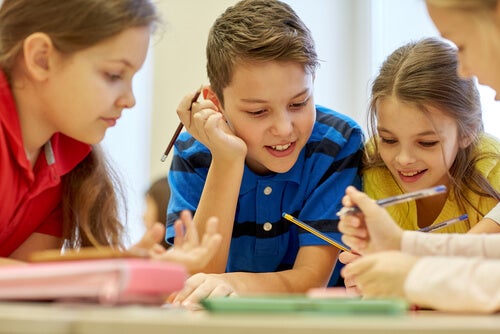
Source
For example, when there is frontal work, the "strong" students are the most active, they are the first helpers in the lesson. The "weak" simply listen, often do not understand what is said, that is, they are passive. Some do nothing at all.
How to "include" all children in the educational process?
When organizing a training session, all types of educational communication are used, various combinations of forms of activity in couple, group, collective and individual.
Each teacher wants to have as many capable students as possible in their class (we call them "strong" students).
Different children come to school: "able" and "less capable", "strong and weak", and each teacher wants everyone to actively participate in the lesson. But ... the question arises, how to include each student in the lesson, both "strong" and "weak".
,It turns out that this problem can be solved by organizing group classes.
Collective training sessions are not just the work of students in pairs. Here, each student in turn works as a teacher or as a student. Each participant is alternately a teacher or a student.
The main objective of each student is to teach others everything you know. The basic principle of work: everyone takes turns teaching everyone, and everyone takes turns for everyone; in other words, the team teaches each member.
One of these technologies is the "Collective learning method"

Source
Collective forms of training organization include working in dynamic pairs or interchangeable pairs. Collective work in pairs of shift workers is fundamentally different from group work and only in pairs. In such classes, each student takes turns working with another.
As a collective method of training, special emphasis should be placed on a form of work such as shift worker occupations in pairs. Such lesson organization not only allows for cooperation, but also takes into account the heterogeneity of student learning skills, to provide everyone with the opportunity to regulate their time to meet and assimilate new material.
Everyone works calmly, at a pace convenient for him and, most importantly, with an individual consultant. Furthermore, the student has the opportunity to go back to the incomprehensible once again, change the consultant and listen to the explanation of others. This form of work is convenient to practice various skills and abilities, to introduce new material and systematize knowledge.
The work in pairs can already be entered from the first class. The main thing during this period is the development of students' ability to negotiate and communicate constructively. Para hacer esto, los alumnos deben cumplir ciertas reglas.
Reglas básicas de comunicación.

Source
- When you speak, look at the interlocutor.
- Speak quietly so as not to interfere with your classmates.
- Call a friend by name, listen carefully to the answer, because then he will correct it, complement it, evaluate it.
It is also necessary to teach students to evaluate each other. You can check the answer, the course of solving the problem, the correction and the beauty of the letter, the task, etc. The next stage is to teach him to train in pairs (sum table, oral score, task execution according to the options followed by mutual verification).
Discussion in pairs means talking about this topic, asking questions and revealing them ("Tell them what I just said"; "Tell a partner how you understood it", etc.). Children should be taught to ask questions correctly. Answer them.
When working in pairs, younger students learn to:

Source
- listen carefully to the response of a friend (because they act as teachers);
- constantly prepare for an answer (it is important that the child is asked);
- learn to speak, answer, test.
The student can do what is not allowed at another time: communicate with a classmate, sit freely. Children really like this type of work.
The time limit and the unwillingness to keep up with other couples encourages students not to be distracted and to communicate only on the subject of the lesson.
This is a way for children who are shy to talk to the whole class. In a narrower circle of peers, shy students start talking, because they know, they will be heard, they will not laugh, they will explain and help if necessary.