How Blockchain works ? Easy and simplified explanation
How Blockchain works Simple and simplified explanation
Blockchain technology is basically just a new way to keep agreements. The big difference between Plucheen's technology and traditional existing methods is that the Plucheen agreement is not centrally maintained by one authority.
To clarify the difference, let us take a closer look at the agreement on the ownership of funds. We will claim that banks maintain agreement on who has something on a single document. The document consists of a list of all clients, their accounts and their balances, and this is agreed between the bank and the customers. Each time the customer wishes to send someone another currency, the bank will notify you that the bank is updating the agreement by offering any - from the sender and the plus + to the addressee and the transaction is done centrally, ie through the bank.
One day, the community decides that they do not want the bank to be responsible for maintaining the agreement again, ie they want to give up the bank in managing their money and accounts. In fact, they do not want any authority to control, manage and maintain their accounts. They decided that anyone could participate in maintaining the agreement if they so wished. Many people in that community accept this role. Let's call people who are involved in maintaining an agreement that they are peer or peer Peers.
Peer to peer Blockchain
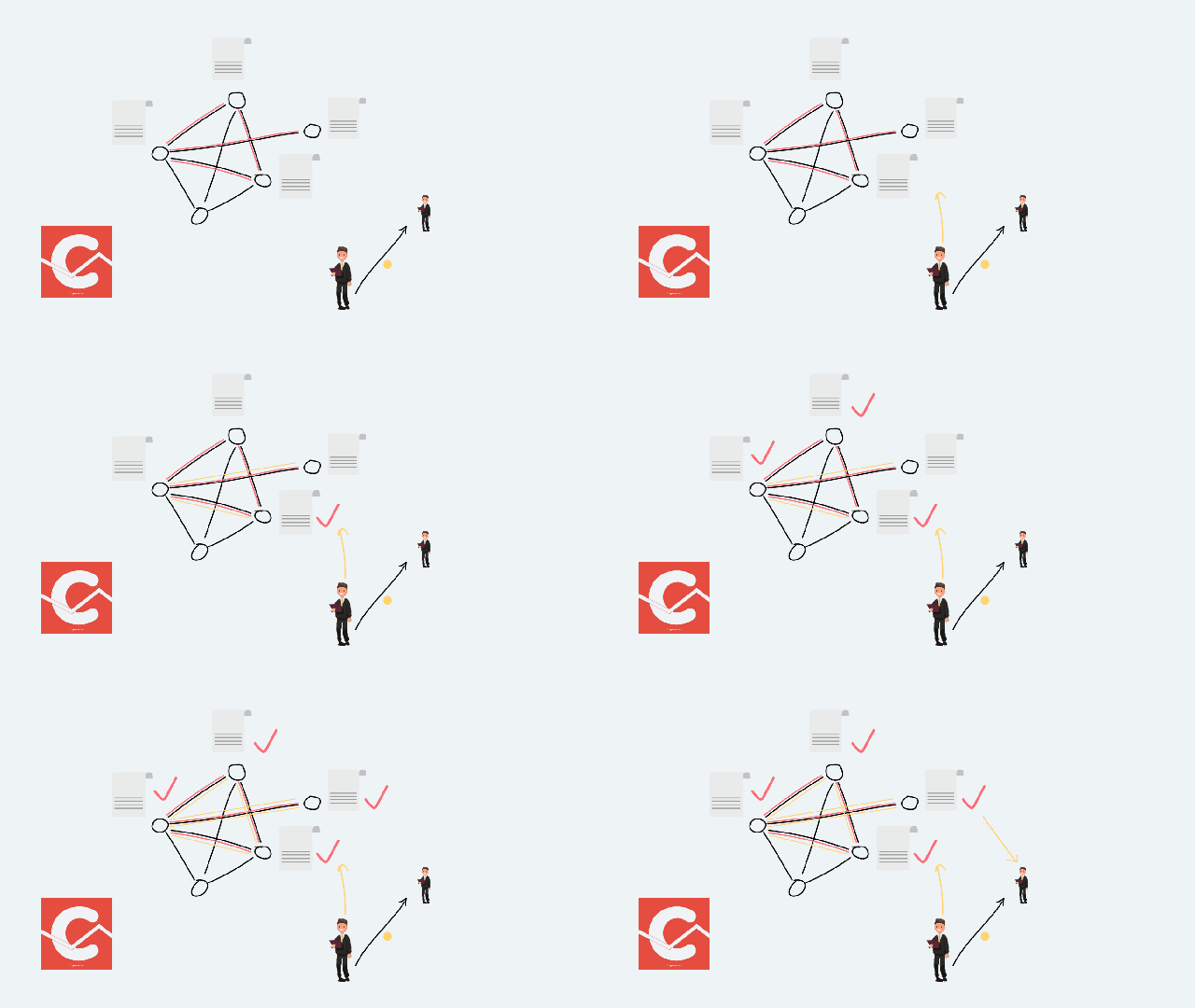
Whenever there is a change in the agreement, that is, each time a transaction is made, all members of the community will have to update the agreement in their possession, since the peer agreement should not differ naturally. In order to ensure that all their peers have the same documented agreement before and after the transaction, they need to meet the update, agree to update, update the agreement, and then sign the unified document for all peers.
For other types of agreements this manual update may be fine, especially if the agreement does not change, or the nature of the agreement changes once every 10 years. But what about the agreements that happen every day, every hour or every second? What was mentioned in the previous paragraph can be in a small community made up of a few individuals, from those individuals in the community. There are those who document these agreements, Each of these peers has similar agreements, in which all transactions, transfers, accounts, balances, or anything that is the nature of an agreement ... which the community agrees to be in the agreement, each time a party of the community wants to change something from the agreement or transform it To another person, peers meet to document the process on all peer agreements in the community. But in today's developed societies it is impossible to do this manually, especially in different societies. We do not know each other and promise the billions. For this purpose, we offer Blockchain technology to act as true peers.
Blockchain technology enables peers to maintain agreement efficiency and make it talk automatically and every second. Just starting out how this blockchain technology works. Here you are asking a deep and technological question, which can be called technical programming magic.
Using the magic metaphor, Blockchain can be imagined as follows:
- A similar agreement is written on a set of documents that are both programmatically and reliably.
- Anyone can participate in maintaining this Agreement by owning one of these public and open source documents.
- The rules describe the changes that you are allowed to make in a document.
Any correct change is made to one document automatically, and to all other documents participating in Blockchain
These magical properties ensure that all peers have an identical and updated version of the agreement. There is no central authority controlling the agreements, and all the peers have a similar replica every second that the transactions are permitted and have been confirmed by the peer. Which is why Blockchain is decentralized, there is no central controller in the real agreement.
Blockchain blocks series
Let's talk about agreements on currency ownership. The magic rules applicable to these documents are:
Each scanned document contains a list of all accounts and corresponding balances.
People have their accounts, and they can send the balance from their own accounts to other accounts.
In essence, these rules are created by the encrypted digital currency, the most prominent example of which is the Bitquin. Unlike Bettkin, in our example, communities suddenly agreed that their calculations would be documented in this new way. The ownership of the currency will be determined as balances next to the accounts of the agreement.
In the real world, no society maintains its currency in this way. For an agreement called Betcuen, the balance in each account is a number only. There is no explicit agreement that this number should be important, as opposed to local currencies in all modern societies whose members are legally required to accept them as a means of payment.
But as of this article, Betquin every day is valued at as much as $ 5,000, which means that many communities agree to this currency and deal with it ...
The bitcoin has value because people, you, it, are, they, I, are willing to trade our money against the Betquin. Thus, we aspire to trade in Bitquin to create an agreement that has value and can increase the value of our financial assets. Just like traditional coins, the only real reason is that the Pitcone has value, because people believe in it in the future.
How Bitcoin works
The Bitquin Convention began in 2009, the software behind the 100% open-source Bitquin protocol, which allows anyone to see how the Magic Blockchain works. This has allowed people to make changes and create copies of the original. In terms of charming software measurements as we called it, the new derivative Blockchain is like other sets of archived documents. These new sets of documents can follow different rules for how to update onlythe agreement.
Although the other rules of balksin are different, they still share the ownership of a list of accounts and balances in essence, so that each blockbuster has a special currency known as encrypted digital currencies. Each public block requires an encrypted digital currency, in order to be able to reward peers who maintain, document and confirm the agreement.
Think of PeteCwin, and other encrypted digital currencies as a digital version of the tangible currency. However, the movement and transfer of money from person to person is not physical. Anytime you send someone a bitcoin, the petkin does not move like $ 10. But Betquin is only a numerical value in the agreement, so when you send a Betquin, the agreement distributed over the ownership of the Betquin is updated among the peers involved in the Plucheen Bitcoin network or any other currency. This is done by subtracting the balance of your account from KFH.
One of the first alternative uses of pluchein was to preserve the ownership of the site. So that instead of centrally managed, the rules governing the ownership of sites can be maintained on the Plucchin network and documented and confirmed by the plocchin.
In addition to creating a pluchein for agreement on digital assets such as digital cash or websites, you can also represent physical assets on the plucchin. The Plucheen Agreement can describe who owns goods, real estate, financial instruments and even current currencies. The same cocaine does not have any power outside its own accord, it can not blame someone if the physical value of gold is not represented on the plaque. However, it is still possible to use the buccaneer as a means of maintaining such agreements if the Convention is given legal precedence or to a reliable third party as a supporter.
Not only is the agreement on the ownership of different types of assets, but the rules of balksin also specify how to manage this property.
- For website ownership, these rules will determine how websites are first acquired through auctions, how to transfer ownership, and rules to prevent people from cheating or cheating on site ownership.
- Blockxin can also be made to retain ownership of the company's shares. It can determine the rules for how dividends are distributed to shareholders, how to vote on these owners, and how to transfer ownership.
- Blocks can determine payment rules if certain conditions are met. Or if you store some data for a period of time and you install it on the blockin, the buxine can make the payment automatically to store the data.
All the above examples describe the balksin with different rules for how to update the convention. These rules can also be considered agreements, more specifically, pre-defined agreements on how to update the agreement.
These agreements on how to update the Blochen Agreement are known as smart contracts or Smart Contrats, and this latter concept is the focus of our next theme, to give you a clear idea of the Blocsin without any cultural complications!