Mars: organic molecules on the Red Planet?
Mars: organic molecules on the Red Planet?

Xavier Demeersman
Journalist
Curiosity has detected several times organic matter on the surface of Mars. But how did she get there? For researchers, these ingredients that can be the source of life would come in large amounts of space.
Organic molecules , the Curiosity rover has detected several times on Mars during his wanderings in the crater Gale and on the foothills of Mount Sharp. As far as their origin is concerned - a big question that appeals to researchers - the main hypothesis remains that of the interplanetary dust that sprinkles the planet. These dusts are solid particles, a mixture of asteroids crumbled by collisions, debris of comets spawned during their crossings of the Internal Solar System and also of ashes of ancient stars trapped in the cocoon of the Sun ... From the primitive matter in short, who has a lot to tell astronomers about the formation of planets and who may have had an implication in the appearance of life on Earth (and perhaps even on Mars).
Not entirely convinced that the organic matter on Mars comes exclusively from interplanetary dust, an international team has embarked on an investigation to identify possible other culprits. And according to their research, asteroids and comets would be no strangers to it.
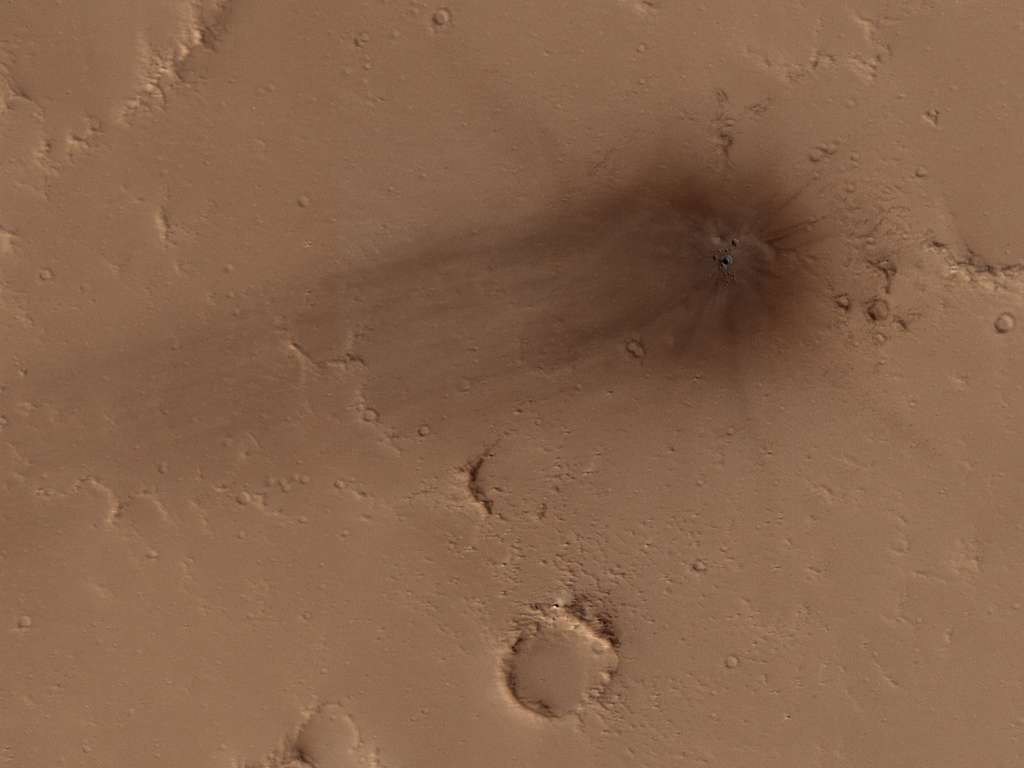
Ejectas around a recent impact crater on Mars. Photo taken by the HiRise camera of the MRO probe. © Nasa, JPL, University of Arizona.
Nearly 200 tons of organic matter would be dumped each year on Mars
According to their research, the equivalent of eight trucks of organic matter is dumped on Mars each year, about 192 tons. The interplanetary dust dominates, accounting for about 67%, or 129 tons. And for the rest, 26% (about 50 tons) of the carbonaceous material would have directly asteroids origin and 7% (13 tons), comets.
The researchers did not obtain these results by taking pinches of dust on the Red Planet, no, they inferred these quantities via simulations of the impact rates of celestial bodies on Mars. "We calculated for the first time the carbon flux from asteroid and comet impacts," they write in their forthcoming study in the journal Icarus . They therefore took into account the celestial bodies circulating in the Solar System. Some are richer in organic matter than others. And for Mars, a planet on the edge of the Main Asteroid Belt , many of the asteroids that have broken on its surface for hundreds of millions of years would be of the dominant C family, that is to say carbon, family representing 75% of asteroids.
For researchers, it would be worth taking a closer look around impact craters, up to 150 kilometers around. For it is there, where the ejectas of the celestial bodies have been scattered, that the Martian rovers should discover the greatest quantities of organic matter .
Obviously, the contribution of these prebiotic ingredients raises the question of the appearance of life on Mars , especially when oceans of liquid water covered its surface, there are more than 3.7 billion years, and that the The weather was warmer than today ... on the Red Planet and elsewhere, on other worlds beyond our solar system. "Near other stars, there are also asteroids and comets that can saturate the surface of exoplanets with carbon ," said Kateryna Frantseva, who led the study. And if, on top of that, there is water, then you have the necessary ingredients for life. This multiplies the chances of discovering a day of life elsewhere.
What you must remember
The organic matter on Mars would be largely of interplanetary origin.
Curiosity arrives near a small clay deposit formed at a time when liquid water existed on the surface of Mars.
The rover will look for organic molecules that could testify to an old biological or prebiotic activity.