
Authored by Lance Roberts via RealInvestmentAdvice.com,
The Rule Of 20
Byron Wien recently asked the question of where we are in terms of the economy and the market to a group of high-end investors. To wit:
“The one issue that dominated the discussion at all four of the lunches was whether or not we were in the late stages of the business cycle as well as the bull market. This recovery began in June 2009 and the bull market began in March of that year. So we are more than 100 months into the period of equity appreciation and close to that in terms of economic expansion.“

Importantly, it is not just the length of the market and economic expansion that is important to consider. As I explained just recently, the “full market cycle” will complete itself in due time to the detriment of those who fail to heed history, valuations, and psychology.
“There are two halves of every market cycle. “
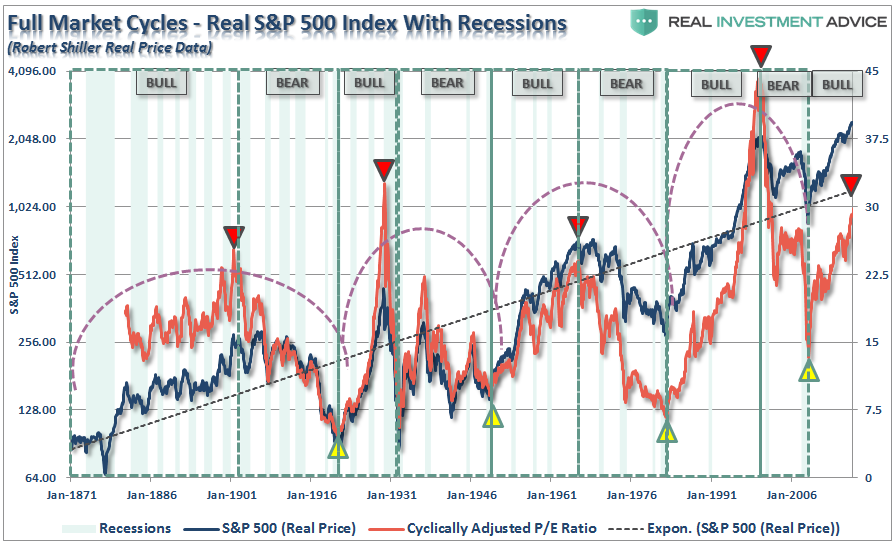
“In the end, it does not matter IF you are ‘bullish’ or ‘bearish.’ The reality is that both ‘bulls’ and ‘bears’ are owned by the ‘broken clock’ syndrome during the full-market cycle. However, what is grossly important in achieving long-term investment success is not necessarily being ‘right’ during the first half of the cycle, but by not being ‘wrong’ during the second half.
Will valuations currently pushing the 3rd highest level in history, it is only a function of time before the second-half of the full-market cycle ensues.
That is not a prediction of a crash.
It is just a fact.”
As Wien states, Howard Marks, via Oaktree Capital Management, and arguably one of the most insightful thinkers on Wall Street recently penned a piece discussing the risk to investors. I suggest you read the whole piece, but here is the relevant passage:
“Today’s financial market conditions are easily summed up: There’s a global glut of liquidity, minimal interest in traditional investments, little apparent concern about risk, and skimpy prospective returns everywhere. Thus, as the price for accessing returns that are potentially adequate (but lower than those promised in the past), investors are readily accepting significant risk in the form of heightened leverage, untested derivatives and weak deal structures. The current cycle isn’t unusual in its form, only its extent. There’s little mystery about the ultimate outcome, in my opinion, but at this point in the cycle it’s the optimists who look best.”
Unfortunately, that was also a repeat of a passage he wrote in February 2007.
In other words, while things may seemingly be different this time around, they are most assuredly the same.
This brings us to the “Rule of 20.” The rule is simply inflation plus valuation and should be “no more than 20.” Interestingly, while the rule is pushing the 3rd highest level in history, only behind 1929 and 2000, Mr. Wien states that such levels only suggest the market is “fully priced” rather than “egregiously overvalued.” Regardless of what definition you choose to use, the math suggests forward 10-year returns will be substantially lower than the last.
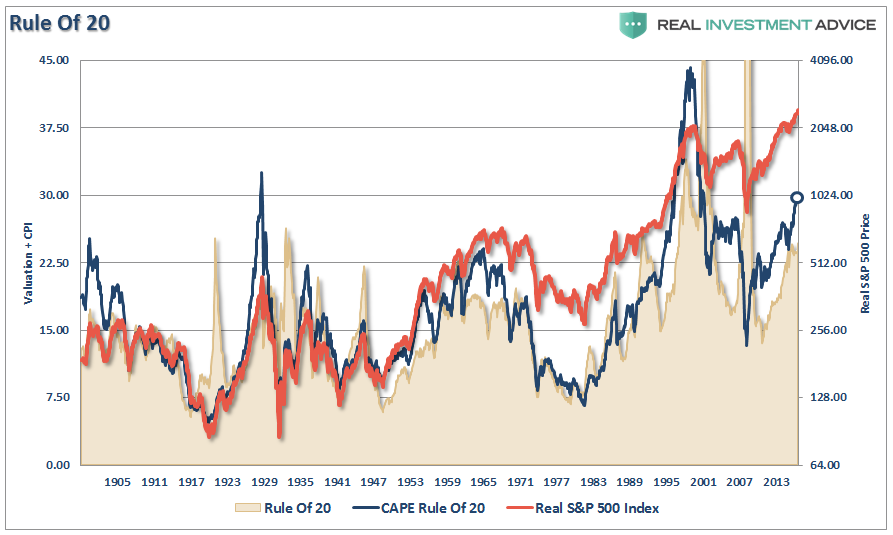
In a market where momentum is driving an ever smaller group of participants, fundamentals are displaced by emotional biases. Such is the nature of market cycles and one of the primary ingredients necessary to create the proper environment for an eventual crash.
Notice, I said eventually.
I do agree the markets are indeed currently bullish and therefore, as stated above, portfolios remain tilted towards equities currently. However, just because fundamentals are currently ignored by “greed” and “momentum,” does not mean such will always be the case.
As David Einhorn once stated:
“The bulls explain that traditional valuation metrics no longer apply to certain stocks. The longs are confident that everyone else who holds these stocks understands the dynamic and won’t sell either. With holders reluctant to sell, the stocks can only go up – seemingly to infinity and beyond. We have seen this before.
There was no catalyst that we know of that burst the dot-com bubble in March 2000, and we don’t have a particular catalyst in mind here. That said, the top will be the top, and it’s hard to predict when it will happen.”
Is this time different?
Probably not.
The Risk To Passive
The other potential danger noted by Wien was ETF’s (Exchange Traded Funds). To wit:
“One other potential danger that investors seem too complacent about is Exchange Traded Funds. While most know these instruments as a great convenience in getting or reducing exposure to sectors or asset classes, they may prove to be less liquid than their participants believe and could destabilize the financial markets.”
But most importantly:
“Most owners of ETFs don’t know what’s in them. What happens when everyone wants to get out at the same time?”
As I noted in “Rise Of The Robots:”
“At some point, that reversion process will take hold. It is then investor “psychology” will collide with “margin debt” and ETF liquidity. As I noted in my podcast with Peak Prosperity:
‘It will be the equivalent of striking a match, lighting a stick of dynamite and throwing it into a tanker full of gasoline.’
When the ‘robot trading algorithms’ begin to reverse, it will not be a slow and methodical process but rather a stampede with little regard to price, valuation or fundamental measures as the exit will become very narrow.
Importantly, as prices decline it will trigger margin calls which will induce more indiscriminate selling. The forced redemption cycle will cause catastrophic spreads between the current bid and ask pricing for ETF’s. As investors are forced to dump positions to meet margin calls, the lack of buyers will form a vacuum causing rapid price declines which leave investors helpless on the sidelines watching years of capital appreciation vanish in moments.
If you don’t believe…just go look at what happened on September 15th, 2008.
It happened then.
It will happen again.”
While investors insist the markets are currently NOT in a bubble, it would be wise to remember the same belief was held in 1999 and 2007. Throughout history, financial bubbles have only been recognized in hindsight when their existence becomes “apparently obvious” to everyone. Of course, by that point, it was far too late to be of any use to investors and the subsequent destruction of invested capital.
This time will not be different. Only the catalyst, magnitude, and duration will be.
Investors would do well to remember the words of the then-chairman of the Securities and Exchange Commission Arthur Levitt in a 1998 speech entitled “The Numbers Game:”
“While the temptations are great, and the pressures strong, illusions in numbers are only that—ephemeral, and ultimately self-destructive.”
But it was Howard Marks which summed up our philosophy on “risk management” well when he stated:
“If you refuse to fall into line in carefree markets like today’s, it’s likely that, for a while, you’ll (a) lag in terms of return and (b) look like an old fogey. But neither of those is much of a price to pay if it means keeping your head (and capital) when others eventually lose theirs. In my experience, times of laxness have always been followed eventually by corrections in which penalties are imposed. It may not happen this time, but I’ll take that risk.”
I will receive a lot of emails from this article trying to pose counter-arguments, explain to me why this time is different, or that I am missing out.
I am okay with that.
Client’s don’t pay a fee to chase markets. They pay a fee to employ an investment discipline, trading rules, portfolio hedges and management practices that have been proven to reduce the probability a serious and irreparable impairment to their hard earned savings.
Unfortunately, the rules are REALLY hard to follow. If they were easy, then everyone would be wealthy from investing. They aren’t because investing without a discipline and strategy has horrid consequences.
So, what’s your plan for the second-half of the full market cycle?

Hurricane Harvey was supposed to be a "1 in a 1000" year storm, in terms of damage. Well, just a few days later we have another "monster" storm to account for, and according to Barclays' analyst Jay Gelb, Hurricane Irma's insured damage in Florida could equal that inflicted by Hurricane Katrina in 2005. Actually scratch that - according to the just released note, Irma’s insured damage in Florida could be the largest ever in the US" with some estimating a repeat of the 1926 Miami
hurricane which could result in $125-130bn of insured damage.
According to Barclays, "in a worst case scenario, catastrophe modelers AIR Worldwide and Karen Clark and Co. have estimated a repeat of the 1926 Miami hurricane could result in $125-130 billion of insured damage", which is substantially higher than the insured damage expected in Texas as much of the damaged property was not covered by flood insurance. This explains why insurer stocks are in freefall today as traders shift their attention from potential damage by Harvey to potential damage by Irma.

With winds topping 180 mps, Hurricane Irma has now been classified as the strongest Atlantic hurricane on record. And as Barclays writes, "this potentially devastating hurricane could directly impact southern
Florida early next week. Given the potential magnitude of this storm as well as the
potential to impact a highly populated area, we think Irma’s insured damage in Florida
could be the largest ever in the US perhaps equivalent to Hurricane Katrina in 2005
($50bn on an inflation-adjusted basis). In a worst case scenario, catastrophe modelers
AIR Worldwide and Karen Clark and Co. have estimated a repeat of the 1926 Miami
hurricane could result in $125-130bn of insured damage."
"We would view Irma as more of a risk to the traditional reinsurers as well as third-party providers of reinsurance capital than the primary commercial insurers and personal lines insurers based on the industry’s long-standing view that Florida poses substantial windstorm risk. Of the companies we cover, reinsurers expected to have among the largest exposures to a Florida hurricane could include RE, XL, VR, RNR, and AHL. Among primary commercial insurers, we would expect AIG to have among the largest exposure."
The reinsurance companies cited by Barclays have seen their stocks fall over 5% today, with Validus down the most at 6.5 percent. XL Group was the single worst performer in the S&P 500, down 6 percent
The good news is that Gelb believes the net exposure (including reinsurance protection) of commercial and personal lines insurers such as CB, TRV, HIG, and ALL should be comparatively limited. Companies with large personal and commercial auto exposure in Florida which could be storm-exposed include Berkshire Hathaway’s GEICO unit as well as PGR. Notably, Berkshire has largely exited the property catastrophe reinsurance market due to weak pricing.
He adds that the possibility also exists for mandatory assessments on insurers from the state’s Florida Hurricane Catastrophe Fund which would add to insurers’ costs, making the hit to equity even worse.
"From the insurance industry's perspective, we would expect a substantial hurricane possibly impacting Florida as well as just after Hurricane Harvey to possibly halt further reinsurance price declines for the first time in many years," concluded the Barclays analysts. "However, insurers' earnings and book values would also be expected to suffer a large hit."
And then, once Irma passes, there is Jose to worry about...

As if the speculation over the potential destruction from Hurricane Irma was not enough, which as of this morning has been dubbed the strongest Atlantic Hurricane in NHC records, a new Tropical Storm - Jose - the 10th of the seasons, has formed over the Atlantic, and according to the latest advisory, "Jose could become a hurricane by Friday."
Meanwhile, #TS_Jose has formed & we're in the cone of uncertainty, meaning after #Irma, #Jose will likely follow.https://t.co/V1XXQT7oKv? pic.twitter.com/cbNGXbfPx2
— Antigua Met Service (@anumetservice) September 5, 2017
In other words, in a worst case scenario just as Florida struggles to emerge from Irma's potential damage, it could be hit with a second hurricane just days behind it.

From the NHC:
At 1100 AM AST (1500 UTC), the center of Tropical Storm Jose was located near latitude 12.3 North, longitude 39.1 West. Jose is moving toward the west-northwest near 13 mph (20 km/h) and a movement toward the west or west-northwest at a slightly faster rate of forward speed is expected during the next two days.
Maximum sustained winds are near 40 mph (65 km/h) with higher gusts. Some strengthening is forecast during the next 48 hours and Jose could become a hurricane by Friday.
Tropical-storm-force winds extend outward up to 45 miles (75 km) from the center.
The estimated minimum central pressure is 1008 mb (29.77 inches).


While traditionally few care about T-Bill auction results, which are usually a rather subdued affair, today was different: with today's $20 billion in 4-Week Bills maturing on October 5, or smack in the middle of the interval when the US is expected to run out of cash absent a debt ceiling deal, there was palpable turmoil in the Bills market, as the yield on the just concluded auction demonstrated.

With the When Issued trading at 1.23%, the just priced auction printed at a high yield of 1.30%, what appears to be a record tail of7 bps, and the highest yield since September 2008. It is also an indication that for all the talk of a reduction in government shutdown/debt ceiling crisis odds, the market will have none of it, as the ongoing "king" in the October bills demonstrates.
The internals were mostly remarkable for the soaring yields, with other components coming roughly in line.:
- High yield 1.300% vs prior six auction average 0.966%
- Bid-to- cover 3.04 vs prior six auction average 3.07
- Dealers awarded 58.5% vs previous six auction average 64.7%
- Direct bidders awarded 16.9% vs prior six auction average 8.6%
- Indirect bidders awarded 24.6% vs prior six auction average 26.6%
Putting the latest T-Bill "Kink" in perspective, the chart below shows just how high the Sept-Oct "hump" has blown out to following the auction.


Despite President Trump, Treasury Secretary Steven Mnuchin and OMB Director Mick Mulvaney’s urgings, it appears that Congress will not combine funding for the Hurricane Harvey cleanup effort with a measure to raise the debt ceiling, according to House Majority Leader Kevin McCarthy. Congress’s decision will create a major headache for the Trump administration in the coming weeks, as it tries to push through a government-funding bill and a measure to raise the debt ceiling over objections of conservatives who are calling for budget cuts and other concessions.
The House will bring a bill to approve the $8 billion in emergency funding requested by the White House early Wednesday, McCarthy said.
McCarthy, who appeared on Fox Business with Maria Bartiromo, tried his best to sound conciliatory, praising the president for meeting with lawmakers and other members of the “Big Six” group that’s supposedly handling tax reform, while adding that a spending bill and debt ceiling hike would inevitably be approved.
“Wednesday morning we’ll pass relief to make sure FEMA has enough money to get moving right now while the cities and counties get the estimates in so we can go farther in providing more assistance. But you’re going to hit that debt ceiling regardless. They’re afraid what Mnuchin is telling us, if you pass just the supplemental they may not be able to put that money forward without getting the debt ceiling raised. The thing I look for is this is an issue that we’re going to have regardless. This is not an issue you want to run away from, but congress has been successful in capping discretionary spending. Now we have.”
McCarthy said not combining the two measures wouldn’t create problems because they inevitably must be passed. Of course, the House is only in session for 12 days this month while the Senate is also in session, so the clock is ticking...
“We will deal with the debt ceiling regardless if Harvey even arrived in America and now we are asking for more money to provide for FEMA so FEMA does not run out of money,” McCarthy told Maria Bartiromo on Mornings with Maria.
“What Munchin is telling us, if you pass just the supplemental, they may not be able to put the money forward without having the debt ceiling raised.”
“What the Treasury secretary and it’s not just him saying it Mick Mulvaney the OMB director and the president are saying it, we have to deal with the debt ceiling regardless of whether Harvey arrived in America. And now we’re asking for more money to provide for FEMA so FEMA doesn’t run out of money. All they’re looking at are the numbers.”
He also stressed that the president is already making progress on tax reform by meeting with lawmakers, and that he expects a reform bill to reach the president’s desk by the end of the year, the administration’s official self-imposed deadline, which is becoming increasingly important to markets.
“Now we’ve got to move to tax to get the economy growing. We will deal with the wall a little later in the year. We have to finish off eight more appropriation bills. We have the budget to get this month. The budget is the beginning of tax reform. It allows us to go to reconciliation to tackle tax reform. All of that will get done this month.”
“This is a very good sign that they’re meeting with the president now. What we’re doing is learning the lessons from health care. Making sure the White House the House and the Senate are on the same page. That’s why I’m an even stronger believer that tax reform gets out of the house this year. We all know the way to make America stronger is economic growth.”
Voting for aid for Texans is an issue that should transcend political squabbling, McCarthy said.
“To those members who don’t want to tackle the tough issues, the sooner we get it done the sooner we can get to greater growth. Economically, Texas is hurting, think about what Texas’s economy contributes to the US.”
While the controversial border-adjusted tax is out, repatriation – another one of Trump’s top nationalist economic policy objectives – could make it into the final bill.
“Bring it back here and invest it in American or return it to shareholders as dividends.”
When pressed about the priorities for tax reform, McCarthy said it would be a package deal tackling both corporate and individual tax-rate reform.
He also couldn’t resist making a subtle dig at his colleagues in the Freedom Caucus, while urging lawmakers to come together to reach an agreement on Tax Reform.
“If a member is out there worried about a tough vote, maybe this isn’t the right job for them. They've got to make decisions to move this country forward and that's what we're doing. The meeting at the White House is the right thing to do, and a good indication that tax reform is happening. Especially coming off of Harvey.”
McCarthy added that he would be in favor of lower the number of individual tax brackets.
“Why are there seven individual tax rates. Let’s make it three.”
To be sure, we await for a response from the president which, thanks to the influence of Chief of Staff John Kelly, might come in the form of an official statement instead of a tweet. As far as the budget is concerned, Trump still needs a plan for neutralizing intransigent Republicans, because he’s not likely to get any support from Democrats.

In China, Foreigners Can Buy a Marriage
China is a dystopian nightmare for many who live there. Yet even the hardcore communist regime cannot keep a little freedom off the black market.
For many immigrants and foreign workers in China, they are even lower on the social ladder than the peasants. These people cannot own property, and often their children are not allowed to attend school.
But someone found a solution. Fake marriages. Foreigners in China are “marrying” Chinese citizens, even when the foreigner is sometimes already married. This helps foreigners living in Beijing buy property there. It also helps migrant workers send their kids to school and meld into a normal life.
This arrangement has increased since China responded to crowded conditions with more restrictions on foreigners. It sounds a lot like foreigners in America who get married in order to obtain a green card.
Governments just can’t keep creative black market businesses from flourishing when their restrictions leave no other choice.
We’ve even heard of straight men in the military marrying other men to take advantage of the benefits.
Prison Time for Thwarting Emissions Regulations
Volkswagen found that they could not design a diesel engine that would meet federal pollution requirements. So instead, they created software that would cheat the regulations.
Now, a Volkswagon engineer has been sentenced to 40 months in prison for his role in faking the emissions standards.
His crime is basically trying to continue doing business while being obstructed by the government. Is America a free country? They arbitrarily limit the products companies can create. Then they throw a man in prison for breaking their stupid rules.
Courts Actually Holding Police Accountable
Let’s end on a positive note. An appeals court has issued a ruling that protects two important ways of holding police accountable.
First, it should be a little harder for police to charge everything that moves with “obstruction.” The court ruling that says the First Amendment protects speech critical of police officers.
The case stemmed from a man who stepped onto his porch while the police arrested his wife in their driveway. He came outside to yell to them that they were overreacting to her failure to obey orders to walk backwards towards them. She was partially handicapped and could not easily comply.
When the man did not go back into his house he was arrested. He never even moved towards the police. He simply spoke to them while they were trying to arrest his wife. That was enough for them to charge him with obstruction.
Turns out they didn’t even have cause to arrest the wife either. She was the passenger in a car which crossed the center line of the road, and then drove for 40 whole seconds before pulling over, into the woman’s driveway.
So the courts said the lawsuit against the officers on Constitutional rights violations may move forward. The court found no reason for them to be granted sovereign immunity, and be shielded from lawsuits.
Unfortunately, the decision was not unanimous. A dissenting judge said he thinks holding police accountable for their actions will make it harder for them to do their jobs.
More bad news: this judge was considered by Trump for the Supreme Court.
Authored by Michael Snyder via The Economic Collapse blog,
On Monday, Hurricane Irma strengthened into a category 4 hurricane, and today became an "extremely dangerous" category 5 hurricane, with some meteorologists are projecting that it will remain so until it eventually makes landfall in the United States. And since a “category 6” has not been created yet, category 5 is as high as the scale goes at the moment.

Over the past couple of days, the track of the storm has shifted “a lot further to the west”, and at this point it appears that Miami is the most likely to take the full force of the hurricane. But as we have seen, trying to forecast the behavior of hurricanes is not an exact science. Irma may never become a category 5 storm, and it may never hit the U.S. at all. Or it may zip past Florida to the south and end up making landfall in the Gulf of Mexico. The truth is that we just don’t know.

But for the moment things are not looking good for Florida, and a state of emergency has already been declared for every single county in the state…
On Monday afternoon, Florida Gov. Rick Scott declared a state of emergency for every county in Florida in anticipation of Irma. A state of emergency was also declared in Puerto Rico earlier in the day.
Another scenario still on the table is that Irma curve northward and miss the East Coast entirely. This would still generate large surf and rip currents along the East Coast. However, this scenario is the least likely to occur at this point.
And as I mentioned above, many are projecting that Irma will become a category 5 storm just a few days from now. The following comes from the Express…
Many projections show the category storm strengtheing to a category 5 hurricane, capable of ripping roofs from houses and causing huge waves and storm surges.
Predictions from both the National Environmental Satellite data and Information Service (NESDIS) and international weather forecaster Ventusky suggest though Irma is currently a Category 3 storm by Thursday she is expected to strengthen to a Category 5.
A category 5 storm has winds of more than 157mph – enough to destroy whole buildings and cause devastating flooding.
But just because the experts are telling us that certain scenarios are likely to happen does not mean that they will actually take place.
In the end, it is entirely possible that Florida may not see a single drop of rain. Hurricane Harvey certainly behaved in ways that nobody was expecting, and I have a feeling that the same will be true for Irma.
As Irma inches closer to Florida, “prepping fever” has hit the public. Grocery stores and home improvement chains are already being flooded with traffic, and this is only going to get worse the closer that Irma gets.
Yes... South Florida is taking Irma seriously. Shelves already are empty! pic.twitter.com/3yqK1johCY
— Cindy Goodman (@balancegal) September 5, 2017
Up here in NE Florida water shelves are empty or emptying fast. #Irma #Irma2017 #Hurricane #Cat5 pic.twitter.com/SZ2xgbdzPR
— Richard Hay (@WinObs) September 5, 2017
The following comes from one local news report…
As Hurricane Irma continues to make its way towards a possible strike on the Southeastern U.S., stores in South Florida are beginning to see a rush for supplies.
Several Publix supermarkets were full before noon Monday as residents grabbed water, non-perishable food and other items.
Another local news report noted that essential supplies were already running low at a Home Depot in south Florida…
With Hurricane Irma churning west, many South Florida residents are taking precaution and stocking up on supplies on Labor Day.
A Home Depot in Royal Palm Beach on Monday morning posted a sign that said they were short of some hurricane supplies, including wing nuts, 5-gallon containers for gasoline and 5-gallon jugs of water.
Publix in So Fl trying to stay ahead of #Irma already pic.twitter.com/2bTPbD3VsT
— Matt Onderlinde (@Weathernerds) September 4, 2017
Those that wait until the last minute are going to find that there is nothing left for them. One resident of Palm Beach Gardens told reporters that the local Wal-Mart in her area is already completely out of water…
“There was nothing at Walmart,” said Bianca Rodriguez of Palm Beach Gardens. “Not even like one thing of water.”
South Florida stores order drinking water, hurricane supplies as jittery locals empty shelves https://t.co/5CjgiopAvE pic.twitter.com/GrjkbXM0UL
— Miami Herald (@MiamiHerald) September 4, 2017
Of course those that have been preparing all along don’t have to run out to the store in a panic.
If Irma hits the United States as a category 4 or category 5 storm, it is going to make history.
Meteorologists are telling us that the United States has not been hit by two hurricanes of at least category 4 strength in the same year in more than a century.
And prior to Hurricane Harvey, a hurricane had not made landfall in this country in about 12 years.
There is still a possibility that Irma could miss us completely, but as CNN’s Tom Sater has noted, “that window is shutting quickly”…
Computer models show the system moving through the Caribbean, and by the end of week, it will turn right toward the north, said CNN meteorologist and weather anchor Tom Sater.
“There is a small window. If it turns sooner rather than later, we could maybe see the system slide by the East Coast into the ocean, but that window is shutting quickly,” Sater said. “It definitely looks like we will be impacted by a major hurricane that is a Category 3, 4 or 5.”
If Irma is indeed a category 5 storm when it hits the U.S., it would completely rip coastal communities to shreds.
There haven’t been too many category 5 hurricanes to make landfall in modern American history, and a direct strike on Miami would be catastrophic. But if Irma bypasses Florida and ends up hitting New Orleans or Houston, we could be talking about a disaster that is absolutely unprecedented in our history.

With spiking above 13, US equity markets appear to be suddenly waking up to the potential that The Fed's constant stream of positivity was smoke and mirrors all along and a September full of massive event risk probably doesn't warrant buying the record high...
As VIX breaks out...

S&P 500 is tumbling towatfs its 50-day moving average...

And Small Caps have plunged through the 50- and 100-day moving averages....


The reason why the VIX has spiked by over 3 vols, or 3.13 to be precise, rising as high as 13.26 as this moment, is being attributed - by several buyside desks - to a "worst case" scenario analysis passed around the trader community from a prominent sellside analyst, according to whom a military outcome in North Korea now appears practically inevitable should North Korea launch its ICBM, as reports overnight have speculated it will do in the coming days.
The report claims that the Trump administration is now a position where it will be virtually impossible to not take military action against North Korea, as the sanctions route has achieved nothing, and absent a trade blockade of N.Korea's ally China, the strategy is unlikely to yield any benefits. Furthermore, as discussed earlier, Russia has officially joined China in publicly stating that it too is now against further sanctions on the rogue regime.
What has attracted particular attention is the listing of next steps, according to which if North Korea launches another ICBM, as it is gearing up to do, it would be impossible for the US to ignore this latest provocation, and some form of military response or retaliation would be forthcoming. It is unclear as this point if such a response would be joined by military reinforcement from South Korea, including ground troops and other military assets, or if it would be confined to limited surgical strikes against critical targets.
The question then posed by both the analyst and traders, is why the market response hasn't been more aggressive to the downside, with one offered response is that the market consensus, if only for the time being, is that the US will not take military action, and instead deterrence by the Trump team (and his close circle of retired military advisors) will be the most likely outcome according to risk assets, something we first suggested weeks ago when Kelly replaced Bannon as Trump's chief of staff.
Then again, with a sudden trapdoor emerging under the S&P, and the sharp move higher in the VIX, the "worst case" scenario appears to be taking hold...


President Trump has threatened a quick termination of NAFTA a countless number of times, with the latest coming just last weekend via twitter:
We are in the NAFTA (worst trade deal ever made) renegotiation process with Mexico & Canada.Both being very difficult,may have to terminate?
— Donald J. Trump (@realDonaldTrump) August 27, 2017
Of course, like with most Trump deals, it's often very difficult to differentiate between bombastic rhetoric utilized for establishing negotiating power and actual desired results. According to Bloomberg, so far the speed of U.S. negotiations, led by Trade Representative Robert Lighthizer, have failed to live up to the President's rhetoric leaving many to question whether a "deal" is the desired outcome for this administration.
The latest Nafta talks are nearing conclusion without a major breakthrough or agreements on even the least-contentious topics, officials familiar with the negotiations say, fueling doubts among observers that a deal can be reached this year.
U.S. Trade Representative Robert Lighthizer is scheduled to speak publicly alongside Mexican Economy Minister Ildefonso Guajardo and Canadian Foreign Minister Chrystia Freeland Tuesday to conclude the second round of talks toward a new North American Free Trade Agreement. Their appearance will cap a five-day session in Mexico City.
While negotiators have made some progress, they have yet to agree on any major contentious issue and are far from a deal on individual Nafta chapters, the officials said, asking not to be identified discussing private matters. On some topics, discussion has been verbal with no specific text proposals submitted, they said.
The talks came after U.S. President Donald Trump threatened outright withdrawal from the agreement. While slow progress is normal in most trade negotiations, the nations have been seeking an unusually quick timeline for Nafta, and officials expressed doubt a deal could be reached by the target date of December. That sentiment is shared by many observers and stakeholders who say the U.S. has been slow in detailing its actual demands.

Meanwhile, folks from all sides attending negotiating sessions in Mexico City have been surprised by the lack of U.S. engagement with one trade strategist from Canada predicting that the earliest date for a possible deal would be February or March 2018.
David Wiens, a farmer and vice president of the Dairy Farmers of Canada, said he’s been surprised by the lack of written and firm policy proposals put forward by the U.S. government. That makes him believe it’s "a bit unrealistic" to get a deal by December.
"What we’re hearing on the ground here is the Americans have still not posted all the texts for the different chapters," Wiens said in an interview in Mexico City. "If there’s a strategy behind all of that, I’m certainly not recognizing it.”
"They can’t possibly finish. The Americans haven’t started negotiating yet," said Peter Clark, a trade strategist and former Canadian official. Jerry Dias, a Canadian labor leader, said he’d "be shocked if it gets done before Christmas."
Clark said the earliest possible date for a deal is February or March, and even then it would likely be an agreement-in-principle that wouldn’t be finalized until after Mexican and U.S. elections. "It’s not really a negotiation. What you have is a president who says he’s been robbed for years," Clark said. "He wants to break a contract without any penalty."
Finally, the most critical component of the NAFTA negotiations (or at least the component that gets all the media attention), auto manufacturing, apparently hasn't even been touched yet.
One key issue without a firm policy proposal is what threshold the U.S. is seeking for the so-called rules of origin on the auto sector -- the share of a vehicle that must be sourced within Nafta countries to receive the pact’s benefits. The current level is 62.5 percent and Dias said U.S. Secretary of Commerce Wilbur Ross wants a "significantly" higher figure.
The auto threshold is "the heart of the American objective," said Flavio Volpe, president of the Automotive Parts Manufacturers’ Association in Canada. "Negotiators will be very careful before pegging a rate that would drive assessments of success or failure.
The outlook isn’t entirely gloomy. One official described a two-track process -- a political one dominated by Trump’s threats, and a more constructive and technocratic track with negotiators plodding forward in search of agreement.
So what say you? Is this all a clever charade from a White House that has no real interest in negotiating and would rather withdraw from NAFTA altogether, or is it all just another sign of a woefully unprepared, chaotic administration?

Source: http://www.zerohedge.com/fullrss2.xml