U.S. NAVY AIRCRAFT HISTORY
I have been meaning to expand on my first discussion of the tailhook (HERE). The recent problems with the F-35C's brought that topic up to first on the list. More on that after a brief history of the tailhook.
The first landing of an airplane on a U.S. Navy ship, the cruiser Pennsylvania, was accomplished by a civilian pilot, Eugene Ely, on 18 January 1911—hence 2011 being the Centennial of Naval Aviation. A temporary wooden platform about 134 feet long and 32 feet wide had been added aft of the mainmast, extending aft over the after turret and past the stern of the ship. It angled upward from the fantail, the first 14-foot section at about a 30-degree angle and the remainder, less steeply but still "uphill" so as to help slow the airplane. Two low, wooden guide rails ran fore and aft on the platform about 12 feet apart to help keep the airplane on the deck. Two low canvas screens were strung across the deck about ten feet from its forward end and a high canvas screen was hung from the mast to the forward end of the platform. These foreshadowed the barriers and barricade respectively used on axial deck carriers to protect the crew forward and hopefully the pilot in the event that the airplane overran the landing area. Canvas was also slung outboard on both sides of the forward two thirds of the landing area to keep the airplane from falling into the sea if it came off the platform. 
The arresting gear consisted of 22 pairs of 50-lb sandbags, each connected by a rope and placed outboard of the guide rails, which helped hold the rope above the deck. Each pair was three feet apart going up the deck. Three steel hooks were attached to the longitudinal frame of the landing gear of Ely's Curtiss pusher. These were intended to snag the ropes, with the bags then dragging the airplane to a stop. (The weight of each bag was carefully measured to insure that they were equal in order to reduce the likelihood of a bag having more drag than its partner and pulling the airplane to the side.)

The arresting system worked exactly as planned. The heritage of today's system is clearly evident. 
It took a few more years of aircraft development before the U.S. Navy was ready to operate land planes from an actual aircraft carrier. The tailhook was instrumental to the success of the enterprise and a closely held inno. 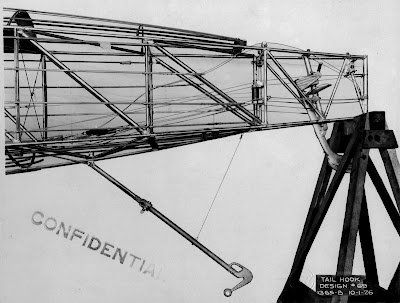
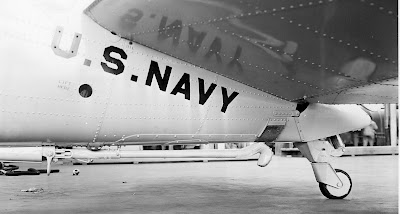
The first arresting-gear systems incorporated longitudinal wires as well as the cross-deck pendants. These were engaged by two-pronged hooks hanging down from the spreader bar between the main landing gear wheels. The purpose was to keep the airplanes from slewing off the deck or bouncing but they soon proved to be more trouble than they were worth and discarded. A successful tailhook design was not as easy as it might seem. The first requirement was structural: the attachment had to withstand a load two or three times greater than the weight of the airplane. Most installations were on the bottom of the aft fuselage, with the hook pivoting down from, in effect, the keel of the airplane ahead of the tail wheel. This was mechanically and structurally simple, but meant that the retarding load of the hook ran below the aircraft center of gravity, causing the nose to pitch down during the arrestment to eliminate the resulting moment. This Grumman SF-1 tailhook is typical:
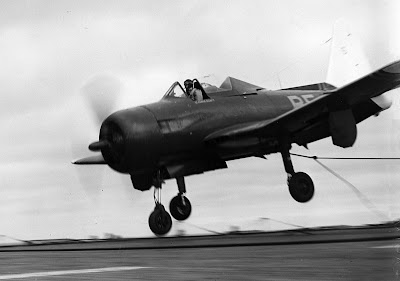
"Tail rise" with a low-mounted tailhook was a problem, as in this Bell Aircraft XFL-1 arrested landing, with the prop dangerously close to pecking the deck:

Tail rise wasn't expected to be a problem because the airplane had a nose landing gear that protected the propeller. However, the length of the hook resulted in inflight engagements and its location, as would be expected, a nose-down pitching moment.
Grumman greatly simplified the mechanics and structure of the aft mounted hook in the F11F. It was stowed upside down and backwards so it simply dropped down from the extreme aft end of the fuselage. After landing, the pilot raised it to the stinger position like the F9F's:


Tail rise problems caused by low-hook attach points were dealt with by beefing up what broke, for example the F8U nose wheel.

In addition to structural and pitching moment concerns dealt with during predesign, the engineers also had to fine tune hook design and operation during development test and Navy evaluation. Hook damping was a cut and try process. Too little damping and the hook would skip, sometimes missing all the wires. Too much was hard on the aircraft structure, not to mention the deck. Hook length might also require experimentation in conjunction with damping changes. Too short a hook and long touchdowns risked missing all the wires; too long and an inflight engagement and overly hard landing might result. Trail angle was another; after problems were encountered in field and at-sea trials, the F4H tailhook operation was modified so that the trail angle decreased after main gear touchdown.
Which brings us to the F-35C. The first roll-in arrestment attempts at Lakehurst in early 2011 were disappointing to say the least: zero traps in eight tries. According to the recently published Quick Look Review of the Joint Strike Fighter Program:
"Root cause analysis identified three key AHS (Arresting Hook System) design issues: (1) the aircraft geometry has a relatively short distance between the aircraft’s main landing gear tires and tailhook point (when lowered), (2) tailhook point design was overemphasized for cable shredding (n.b. the tendency for the hook point to dig into and damage the cable) features versus ability to scoop low positioned cables, and (3) tailhook hold-down damper performance is ineffective to support damping of small bounces relative to runway/deck surface profiles."This picture provides an approximation of the height of the hook above the deck relative to the main landing gear with the oleos fully extended with the F-35C at my guess at its angle of attack on approach. Note that the hook point is not below the wheels as it is on most other carrier-based airplanes and much closer to the wheels horizontally. Contrast this hook-point position relative to the wheels both vertically and longitudinally with that of an F-18F Super Hornet's:

source>http://thanlont.blogspot.com/2011/12/brief-history-