How to handle those “Terrible Two’s”
Every parent or foundation phase teacher reading this, knows exactly what I'm talking about. That sweet little baby from the maternity ward, grows up a little every day, learns to crawl and to sit. He/she is the cutest little thing at first until that little one learns to walk and starts showing devilish behavior, has a problem with each and every little detail, every single moment of every single day and this can lead to very embarrassing moments out in public areas. Every mother thinks she is handling it in the wrong way and usually ends up feeling bad as other moms seems to be handling it much better.
Well, mommy, there is a way... and this is how!

Anger refers to a strong emotional reaction that is primarily socially instigated, often under conditions of threat or frustration. Early reactions may be caused by objections to routines (such as dressing, eating or sleeping), conflict with parents over authority, disagreement with friends over possession of toys and physical discomfort. General responses to anger in young children are aggression outbursts or active resistance to reasonable requests. The negativity, stubbornness, resistance and temper-tantrums of two- or three-year-olds (also called the terrible two’s) are well known.

As children grow older, there is a shift from unreserved violent reactions to more subdued and controlled responses. By the time children reach school age, many have learned to control overt reactions to anger. Children learn to control anger through the process of socialization. This implies that there will be cultural variations in how children deal with anger.
For example, in certain cultures child-rearing practices include promoting interdependency, concern for others and subtle expression of emotions. These children respond to interpersonal conflict with sadness and fear, and prosocial behavior.
On the other hand, in other cultures child-rearing strategies are characterized by independence, self-actualization, assertiveness and the open expression of emotions. These children will typically respond more aggressively, assertively and overtly in conflict situations.

To keep children’s angry feelings from erupting into harmful actions, these feelings need to be acknowledged, while the child has to be taught how to deal with them effectively. In addition, limits need to be set for angry acts. Consider the following example:
“I know you are angry with John for breaking your toy…” (acknowledging feeling)
“…but I cannot allow you to hit him” (setting limits)
“Let’s see if we can fix it” (setting an example for appropriate action)
The child should learn that although angry feelings are natural, certain actions, such as hitting other children or parents, being cruel to animals and destroying property, are not permitted.

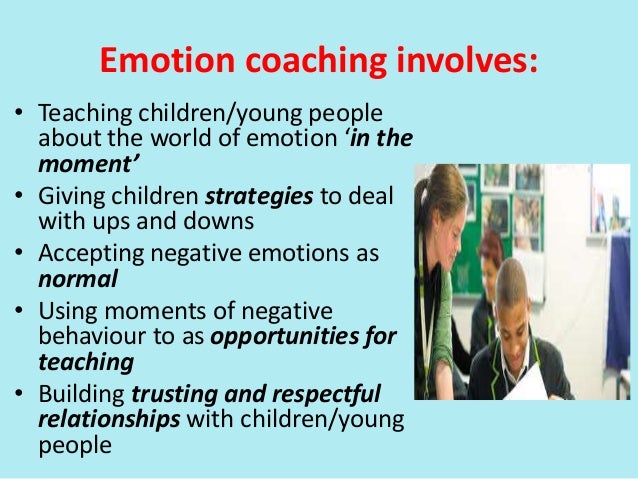
Parents can play an important role in helping young children regulate their emotions, for example by the way that they talk to them, especially with regard to negative emotions such as anger, frustration and sadness. Parents who have an emotion-coaching approach monitor their children’s negative emotions as opportunities for teaching, assist them in labelling emotions and coach them how to deal effectively with emotions. They interact with their children in a less rejecting way and nurture them.
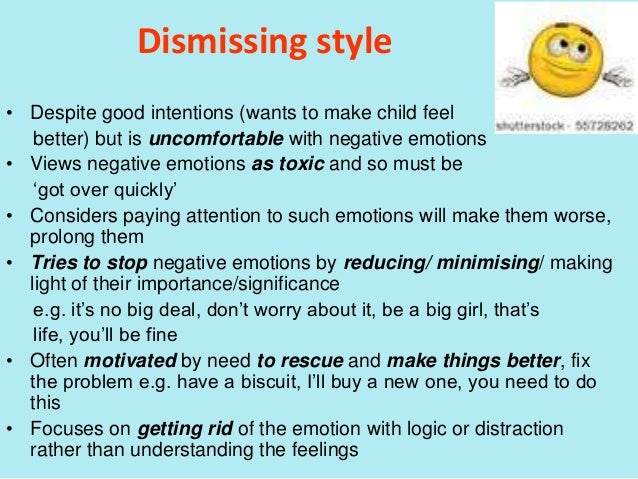
In contrast, parents who have an emotion-dismissing approach view their role as one to deny, ignore or change negative emotions. Children of such parents generally show poorer regulation of emotion, less focused attention and more behavior problems than children of emotion-coaching parents do.

Congratulations! This post has been upvoted from the communal account, @minnowsupport, by Belinda from the Minnow Support Project. It's a witness project run by aggroed, ausbitbank, teamsteem, theprophet0, and someguy123. The goal is to help Steemit grow by supporting Minnows and creating a social network. Please find us in the Peace, Abundance, and Liberty Network (PALnet) Discord Channel. It's a completely public and open space to all members of the Steemit community who voluntarily choose to be there.
If you like what we're doing please upvote this comment so we can continue to build the community account that's supporting all members.
Parenting is really challenging
It is! We just have to make it work!
i dont know really about embarrassing moments and public area.. i always thought about those parents and kids like, ok one day i will have such little monster too, and he-she will be the worse..
what can i say, im living my dream atm
lol
but seriously, im failin to care about what will people think, when its about toddlers.
Not everybody feels the same way. People who don't have children and people whose children are already grown, fail to see it in that way (that it's just a toddler) and they are irritated by children throwing tantrums in the mall or in an airplane. They think that it's the parent who does not discipline their children and would even go so far as to make a confrontation out of it. That is when it's embarrassing for parents. Usually the toddler would make a bigger scene in a public area than he/she would normally do at home. Kids are kids...and toddlers are toddlers.
Enjoy living your dream. I am envious of people like you...well, sometimes, lol!
well its true that people lose their minds and even start confronting parents, but as i said, its their problem. i am just trying to pretend how embarrassed i am :D
Excellent strategy! I hope not to have another toddler anytime soon, but if I had, it would have been awesome to handle it your way ;)
i have 3 yr ld girl. and i am sure she feels i am having fun with her tantrums, so she reduces it big way. its not fun for her if she cant cause reactions she wants.
You mean like this? lol
well this is great idea lol
😂 hahaha! It's funny! Try it then let me know how it went. Lol. Make a video!