NEBULA
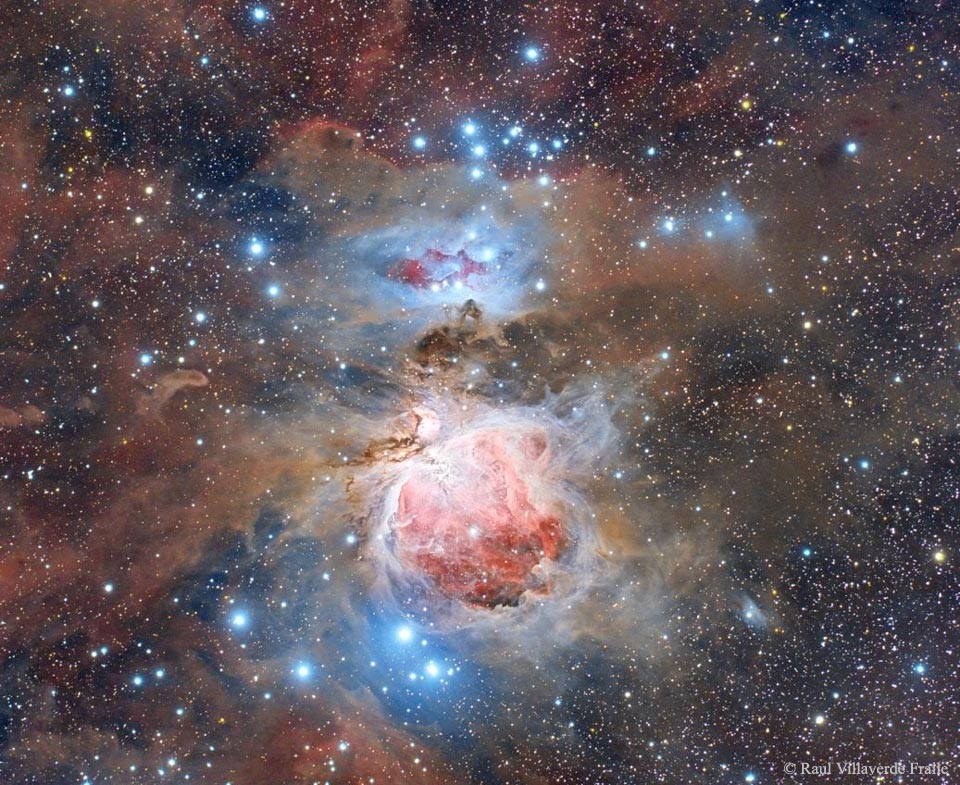
For those of you who have telescopes, you may often point your eyes toward the constellation of Orion stars, and see there is a bright nebula in the heart of the constellation.
The nebula itself is a word taken from Latin meaning "cloud". Nebulae are interstellar clouds consisting of dust, hydrogen, helium and other ionized gases. Initially, the nebula is the name for all seemingly spreading astronomical objects, including galaxies outside the Milky Way.
More than one nebula is called a nebulae. The nebula is the basic building block of the universe. They contain elements in which stars and solar systems are built. They are also among the most beautiful objects in the universe, shining with rich colors and spinning light. Stars in this gas cloud cause them to glow with beautiful red, blue, and green. The colors are the result of different elements inside the nebula. The nebula consists mostly of about 90% hydrogen, 10% helium, and 0.1% heavy elements such as carbon, nitrogen, magnesium, potassium, calcium, iron.
Cloud material is quite large. In fact, they are one of the largest objects in the galaxy. Many from them, are dozens or even hundreds of light years in diameter. The nebula has been divided into five main categories. Namely emission nebula, reflection nebula, dark nebula, planetary nebula, and remnants of supernovae. Emission and reflection nebula tend to be fuzzy in appearance and deficiency in a real form or structure. They are also known as diffuse nebulae.

The Formation Process of Nebula
Most of the nebulae or stars are usually formed from gas gravitational collapse in the interstellar medium. When the material of a star collapses by its own gravity, new large stars can form in the middle of the nebula, and ultraviolet radiation from these new stars will ionize the surrounding gas, so that the interstellar clouds can be seen at optical wavelengths.
There are also other nebulae formed as a result of supernova explosions; a gigantic death of a giant short-lived star. Material thrown from a supernova explosion is then ionized by energy at its core, which is usually a neutron star.
The process of formation of the last nebula is the planetary nebula. This type of nebula is the final stage of the life of low-mass stars, like the Sun. Stars with masses of about 8-10 solar masses would evolve into red giants and gradually lose their outer layers during turbulence in their atmosphere.
Here are some types of nebulae and the process of formation:
1. A Beautiful Boomerang Nebula
Boomerang Nebula was first formed by high-speed winds of gas and dust from aging middle stars at wind speeds of nearly 600,000 kilometers per hour. This rapid expansion makes molecules in nebular gas cold by a temperature of one degree above absolute zero, making it the coldest known region in the distant universe. This nebula shines with the light from the central star reflected from the dust, the cold Boomerang Nebula is believed to be a star system that progresses to the planetary nebula phase. The above Hubble images are recorded using a polarizing filter. The Boomerang nebula has a diameter of about one light year and is about 5,000 light years away from the constellation Centaurus.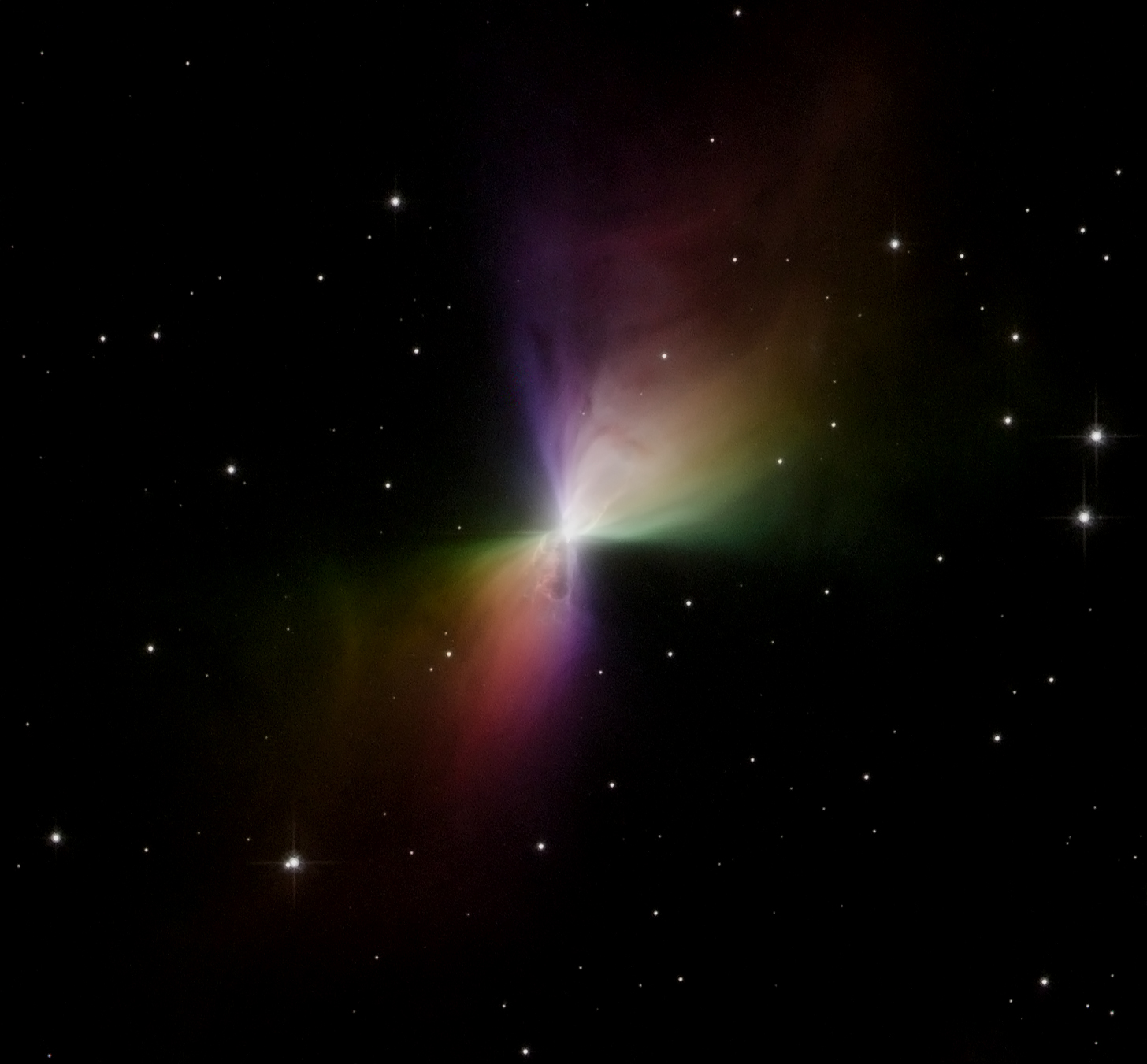
2. The Horsehead Nebula in Orion
The Horsehead Nebula in Orion is the most recognizable nebula in the sky, this nebula is formed from a large and dark part of the molecular cloud. This nebula is known as Barnard 33, this unusual form was first discovered in the late 1800s. The red light from the nebula comes from the hydrogen gas behind the nebula ionized by a bright star near the Orionist Sigma. NGC 2023 surrounds the bright star in the lower left. The darkness of the Horsehead area is caused by thick dust. The gas flow is channeled by a strong magnetic field. The bright spot at the Horsehead base is a young star in the process of formation. The light takes about 1500 light years to get to earth. The picture above was taken Using a 0.6 meter telescope at Mt. Lemmon SkyCenter in Arizona, USA.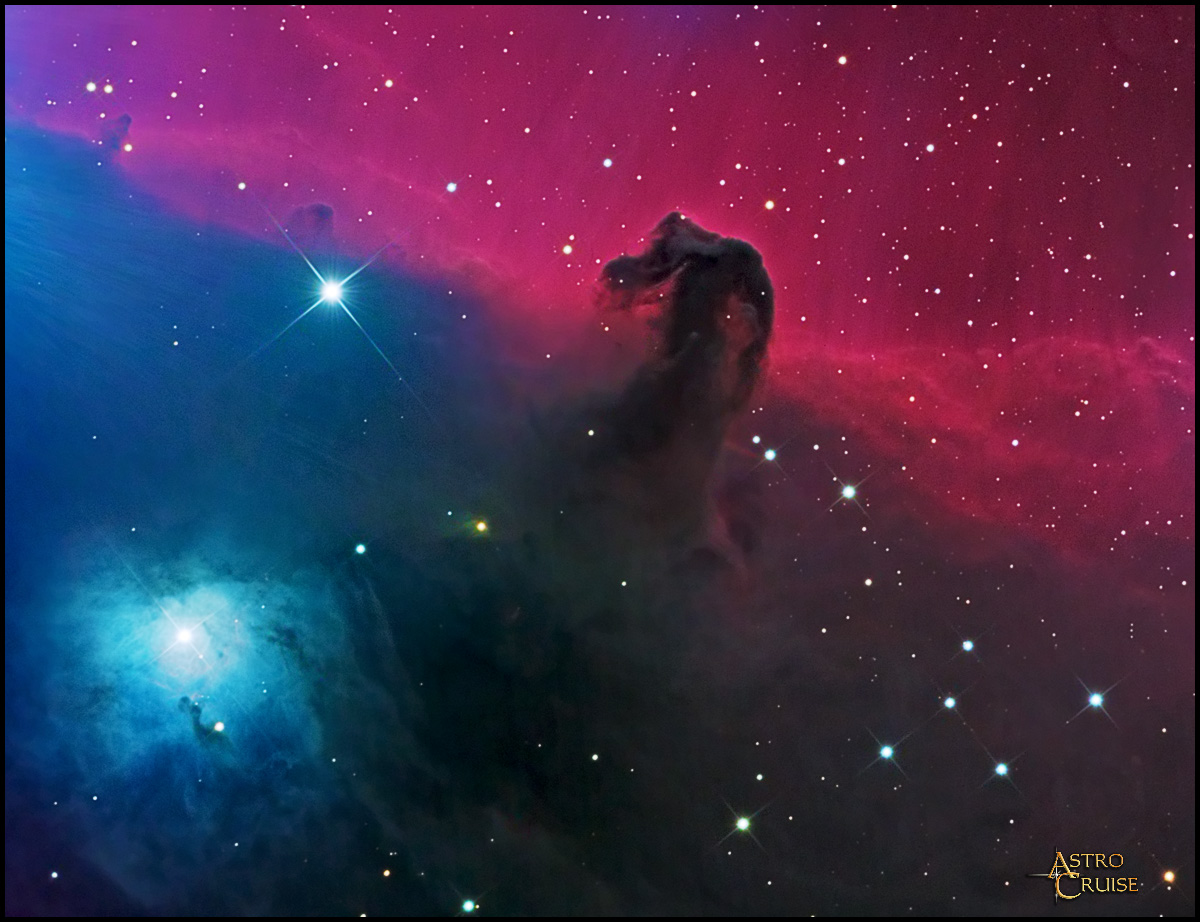
3. Light from the Heart Nebula
The large emission nebula dubbed IC 1805 has a human-like shape. Nebula that has a bright red beam emitted by the most prominent element of hydrogen. The red light is caused by a small group of stars near the center of the nebula. The nebula cover about 30 light years contains many stars above. This open set of stars contains several bright stars that are nearly 50 times the mass of our Sun, the Heart Nebula is located about 7,500 light-years away toward the constellation Cassiopeia...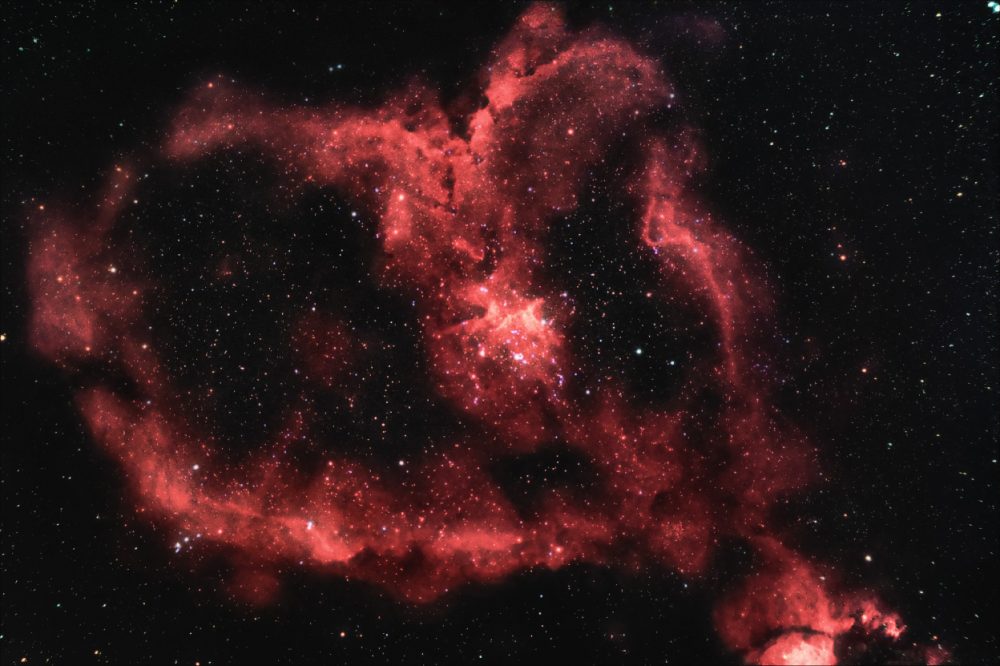
4. The Dumbbells
from this picture we can see there are two nebula that make it, while the nebula is M27 (left) and M76, known as The Dumbbell and the Little Dumbbell. Both are planetary nebulae or shrouds of gas thrown by stars that resemble the sun in physical size, in light years or more. In each panel, images are made on the same scale, so the size difference is seen mainly because the one is closer. Estimated distances suggest 1,200 light-years for Dumbbell and 3,000 light-years or more for Little Dumbell. These narrow and narrow blue images show some very complex structures on M27 and M76, which highlight emissions from hydrogen, nitrogen and oxygen atoms in cosmic clouds.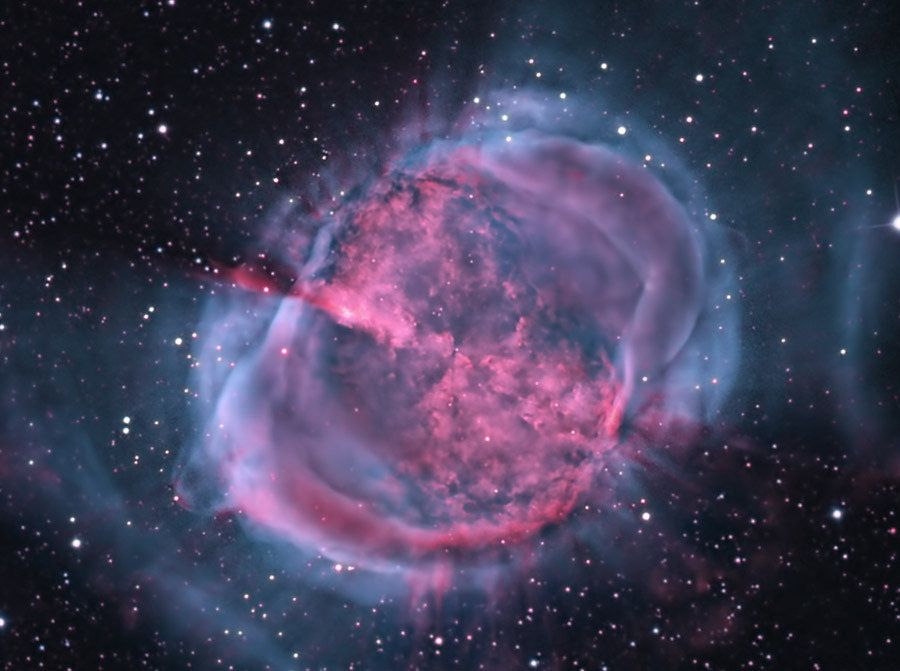
best Regard @alf4t1h
Reference :
Congratulations! This post has been upvoted from the communal account, @minnowsupport, by alf4t1h from the Minnow Support Project. It's a witness project run by aggroed, ausbitbank, teamsteem, theprophet0, someguy123, neoxian, followbtcnews, and netuoso. The goal is to help Steemit grow by supporting Minnows. Please find us at the Peace, Abundance, and Liberty Network (PALnet) Discord Channel. It's a completely public and open space to all members of the Steemit community who voluntarily choose to be there.
If you would like to delegate to the Minnow Support Project you can do so by clicking on the following links: 50SP, 100SP, 250SP, 500SP, 1000SP, 5000SP.
Be sure to leave at least 50SP undelegated on your account.
To know more about winners list : click here