Rambutan "lychee"

Rambutan is a fruit that grows on a tropical tree up to twenty meters high, in Indonesia, Malaysia, Thailand, Java, Florida, Guyana and which, in our latitudes, is grown in a greenhouse but fruiting with difficulty. It is not at all rustic.
The dark green, oval, evergreen leaves are 30-40 cm long, leathery, shiny, and consist of 5-7 pairs of leaflets about 10 cm long.
This lychee therefore resembles its cousin, Litchi sinensis: the hull, which is reddish to orange with hairy thorns, is removed to eat the fruit pulp, which is rich in vitamins C, iron and calcium. Of ovoid shape, the same fruit measures around 3 to 6 cm approximately. Its flavor is sweet, slightly acidic.
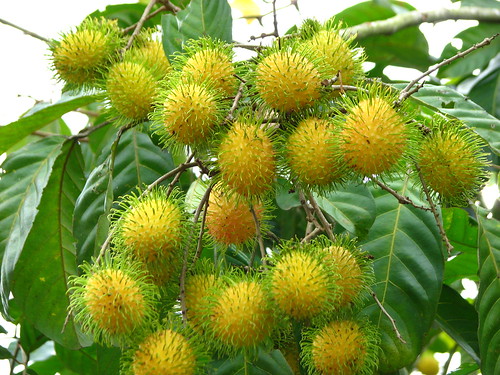
Rambutan is a fruit that is also called lychee hair because it resembles litchi and belongs to the same family of Sapindaceae (rambut means hair in Malay, Malaysia being his country of origin). It is however larger (my copy is well 5 cm). Its sweet flavor is reminiscent of lychee and grape. Its thick skin is a carapace bristling with supple spines, the flesh is white and is easily detached from the bark.

It is a fruit of season since the period of fructification extends from September to December, but it is unfortunately imported since it prefers the humid heats of the Far East (Thailand, Malaysia, Vietnam, China ...) . It has no particular virtue except that of being rich in vitamin C and minerals (especially potassium and iron).
Rambutan is eaten raw or cooked, confit or dried, as an accompaniment to meat dishes in sauce, jam, fruit salad, there are a thousand and one ways to accommodate it.
It is an elongated tree 10 to 20 meters high which only starts to bear fruit after five years. But then he produces about 200 kilograms of fruit a year, from February to April in Tahiti. The flowers are small (5 mm) and pointed and without petal but with 4 to 6 sepals.
Rambutan, a fruit with juicy and sweet flesh

The fruit, rambutan, ovoid, is 4 centimeters in diameter. The color of its skin varies from green-orange to dark red. The skin is covered with soft spines 1 to 2 centimeters long, which gave it the name of "rambut" which means hair in Malay. The juicy, whitish and translucent flesh, which covers a flattened core, has a sweet and fragrant flavor, more or less acidic depending on the variety.
Rambutan is eaten plain, after removing the skin, alone or in fruit salad with yoghurt or ice cream. It is also eaten cooked with vegetables and meat or poultry in Asian cuisine. It is also found in jam, canned or simply dried fruit.
For digestion and against headaches

The fruit is rich in vitamin C, iron and potassium. It contains several nutrients such as glucose. It reduces fever, promotes digestion and kills intestinal parasites. The dried fruit bark is used to relieve diarrhea and dysentery. The leaves, applied as a poultice on the temples, relieve headaches. A decoction of roots and infusions of dried leaves soothe fevers. A paste of crushed rambutan leaves promotes hair growth. A paste of crushed seeds moisturizes the skin and makes it healthier and softer. Be careful, the seed is narcotic and the skin of the fruit is toxic.
How to eat rambutan

1-Choose ripe rambutan. These fruits are first green, then they turn red, orange or yellow when they ripen. Soft hair-like spines are green when rambutan is freshly picked, but the fruit is still good to eat for a few days when these growths darken.
2-Nick the skin. Hold Rambutan firmly on a flat surface by grasping it at both ends. Pass a sharp knife well sharpened in the middle of the fruit as if you were going to cut it in two. Cut carefully to detach the hair envelope from the flesh of the fruit without cutting it. Pass the knife under the skin of the fruit to detach it.
You can also remove the skin with the thumb of your thumb, or even bite into a piece of bark to open it. The spines are soft and harmless, but the skin is inedible and may have a bitter taste.
3-Open the rambutan. The skin should come off easily from the flesh. Peel the skin completely from one half of the fruit, as if you were peeling off the flap of an envelope. Inside you will find a grape-like fruit, oval, slightly translucent, white or pale yellow in color.
4-Press on the skin to sprout the edible part of the fruit.
5-Remove the kernel. The latter is not edible when it is raw. Cut into the flesh without cutting the kernel and try to extract it. Some varieties of rambutans have nuclei that peel off easily, while others adhere more to the flesh.
6-Eat the fruit. Just put the flesh in your mouth when you removed the kernel. When you eat the fruit with the kernel, know that it has a fairly hardy texture. Nibble the flesh around the pit and avoid biting it.
Most rambutans are sweet and juicy, but others may be slightly acidic and slightly drier.
The kernels of most rambutans are bitter, but some may be slightly sweet. The kernels contain traces of potentially toxic substances, but they are rarely consumed. It is not recommended to eat them, especially children or pets.
It is the first time that I heard Rambutan can work against fever and headache. I know that it increases digestion by experience. Thanks for your information.
Great post buddy!
اين انت يا عبد القادر
i upvoted and followed you, so please upvote and follow me